
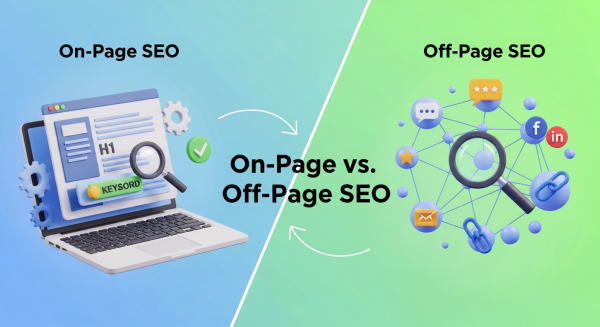
The Difference Between On-Page and Off-Page SEO (and Why Both Matter)
As a small business owner, you know how important it is for customers to find you. In today’s digital world, that means showing up on Google. Search Engine Optimization, or SEO, is the key to making that happen. But SEO isn’t just one single task; it’s a comprehensive strategy with two critical halves: on-page SEO and off-page SEO. Understanding the difference—and how they work together—is your first step toward dominating search results and driving real growth.
Think of it like building a fantastic new restaurant. On-page SEO is everything you do inside: crafting the perfect menu, creating a welcoming atmosphere, and ensuring your staff gives great service. Off-page SEO is everything you do outside to build your reputation: getting rave reviews in the local paper, being recommended by food bloggers, and earning a reputation as the best spot in town. You need both to thrive, and the same is true for your website.
What is On-Page SEO? The Foundation of Your Website
On-page SEO includes all the measures you take directly on your website to improve its position in search rankings. It’s about making your website clear, trustworthy, and valuable to both search engines and human visitors. When Google’s crawlers analyze your site, they are looking for signals that tell them what your content is about and whether it’s a high-quality result to show users. On-page SEO is how you provide those signals.
This is the foundational work. Without a solid on-page strategy, any off-page efforts you make will be far less effective. You can’t build a great reputation on a poorly built website.
Key Elements of On-Page SEO
Optimizing your on-page SEO involves several core components that work together to create a seamless experience. Here are the most important ones for any small business:
- High-Quality Content: This is the heart of on-page SEO. Your content—from blog posts to service pages—must be original, informative, and relevant to what your audience is searching for. It should answer their questions, solve their problems, and establish you as an expert in your field.
- Keyword Optimization: Keywords are the terms people type into Google. By strategically including these terms in your content, headers, and titles, you help Google understand what each page is about. The key is to do this naturally, not “stuff” them in where they don’t belong.
- Title Tags and Meta Descriptions: Your title tag is the clickable headline that appears in search results, and the meta description is the short summary underneath. Compelling, clear, and keyword-rich titles and descriptions can dramatically improve your click-through rate.
- Clear Site Structure & Headings: Using headings (like H1, H2, H3) to structure your content makes it easier for visitors to read and for search engines to understand the hierarchy of your information. A logical structure is a win for both users and SEO.
- Website Performance: How fast your site loads and whether it works well on mobile devices are massive ranking factors. A slow, clunky site frustrates users and sends negative signals to Google. A professional Website Design Service ensures your site is built for both speed and mobile-friendliness from the ground up.
- Internal Linking: Linking to other relevant pages on your own website helps guide users to more useful information and allows search engines to discover more of your content. It also helps spread authority throughout your site.
What is Off-Page SEO? Building Authority and Trust
Off-page SEO refers to all the actions you take outside of your website to impact your search engine rankings. While on-page SEO is about what your site says about itself, off-page SEO is about what the rest of the internet says about your site. It’s how you build credibility, authority, and trust.
Search engines like Google want to recommend the most trustworthy and reputable sources. Off-page signals are the primary way they measure this. A site with a strong off-page profile is seen as a more reliable and authoritative resource, leading to higher rankings.
Key Elements of Off-Page SEO
Building a strong reputation online involves a variety of tactics. For small businesses, these are the most impactful:
- Backlinks: This is the cornerstone of off-page SEO. A backlink is a link from another website to yours. As explained in this comprehensive guide from Moz, search engines view high-quality backlinks as votes of confidence. When an authoritative site links to you, it signals that your content is valuable and trustworthy.
- Local SEO: For businesses serving a specific geographic area, local SEO is non-negotiable. This involves optimizing your Google Business Profile, gathering customer reviews, and ensuring your business name, address, and phone number are consistent across local online directories.
- Social Media Marketing: While links from social media posts don’t carry the same weight as a traditional backlink, a strong social media presence drives traffic, builds brand awareness, and can lead to others discovering and linking to your content.
- Brand Mentions: Even when another website mentions your brand name without linking to you, search engines can pick up on these signals. Consistent brand mentions across the web help establish your business as a legitimate entity.
On-Page vs. Off-Page SEO: A Team Effort
It’s clear that this isn’t an “either/or” situation. The most successful digital marketing strategies integrate both on-page and off-page SEO. They are two sides of the same coin, and one cannot reach its full potential without the other.
You can have the most perfectly optimized website in the world (great on-page SEO), but without any backlinks or authority signals (off-page SEO), Google may not see it as credible enough to rank on the first page. Conversely, you could have amazing backlinks pointing to your site, but if the site itself is slow, poorly written, and confusing, visitors will leave immediately, and Google will take notice.
A strong SEO Strategy starts with a solid on-page foundation and then uses off-page techniques to build authority and amplify its reach. For a complete overview of best practices, Google’s own SEO Starter Guide is an excellent resource that underscores the importance of a holistic approach.
Putting It All Together for Your Small Business
So, where do you start? Begin by ensuring your on-page SEO is in order. Your website must be technically sound, mobile-friendly, and filled with high-quality content that genuinely helps your target audience. From there, you can focus on building your reputation across the web through local SEO, encouraging reviews, and creating content so valuable that other sites will want to link to it.
Executing a comprehensive SEO plan takes time and expertise. Today, many businesses are even leveraging AI Automations for Small Business to streamline content creation and data analysis, making it easier to manage both on-page and off-page efforts. The goal is to create a powerful, self-reinforcing cycle: great on-page content earns off-page authority, which in turn drives more traffic to your optimized site.
Ultimately, mastering both on-page and off-page search engine optimization is fundamental to achieving sustainable online visibility. By focusing on creating a fantastic user experience on your site and building a stellar reputation off of it, you’re not just pleasing an algorithm—you’re building a stronger, more resilient business that customers can find and trust for years to come.
If you’re ready to transform these insights into a powerful growth engine, our team is here to help you build a comprehensive strategy. Book your free, no-obligation consultation today to discover how we can elevate your online presence.