
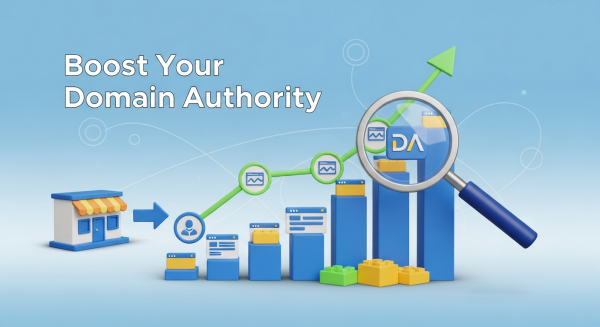
A Small Business Guide to Improving Your Website’s Domain Authority
What Is Domain Authority and Why Should You Care?
In the competitive world of digital marketing, you’ve likely heard the term “Domain Authority” or “DA.” But what does it actually mean for your small business? Think of Domain Authority as a credit score for your website. It’s a metric developed by the marketing analytics company Moz that predicts how well your website will rank on search engine result pages (SERPs). The score ranges from one to 100, with higher scores corresponding to a greater ability to rank.
It’s crucial to understand that Domain Authority is not a ranking factor used by Google. It is a predictive, third-party metric. However, it is an incredibly useful benchmark because it’s based on factors that Google *does* value, primarily the quantity and quality of backlinks pointing to your site. A higher DA score is strongly correlated with higher search engine rankings, which means more visibility, more traffic, and ultimately, more customers for your business.
For a small business, a strong Domain Authority helps you compete against larger, more established players in your industry. It signals to search engines that your website is a credible, trustworthy, and authoritative source of information. Building your DA is a long-term investment in your brand’s digital foundation and its ability to attract organic traffic for years to come.
The Foundation: Start with Flawless Technical and On-Page SEO
Before you can effectively build authority, you need to ensure your own house is in order. You can’t build a skyscraper on a shaky foundation, and the same is true for your website. Search engines need to be able to easily crawl, understand, and index your site. This is where technical and on-page SEO come into play.
Master Your On-Page SEO
On-page SEO refers to all the measures you take directly within your website to improve its position in the search rankings. It’s about creating content that is valuable to your audience and easy for search engines to interpret. This includes optimizing your title tags, meta descriptions, headers, and images with relevant keywords. Most importantly, it involves creating high-quality, original content that answers your customers’ questions and establishes your expertise. A well-executed SEO strategy is the engine that drives authority, turning your website into a valuable resource that both users and other websites want to reference.
Ensure Impeccable Technical Health
Technical SEO is the work you do behind the scenes to ensure your website meets the technical requirements of modern search engines. A technically sound website provides a better experience for users, which Google rewards. If your site is slow, difficult to navigate on a mobile device, or full of broken links, both users and search engine crawlers will be frustrated. This can severely hinder your ability to rank, regardless of how great your content is.
Key elements of a technically healthy website include:
- Fast Loading Speed: Pages should load quickly to reduce bounce rates.
- Mobile-Friendliness: Your site must look and function perfectly on all devices, from desktops to smartphones.
- Secure Connection (HTTPS): An SSL certificate is a must-have for security and user trust.
- Clean Site Architecture: A logical structure makes it easy for users and search engines to find pages.
- An XML Sitemap: This file acts as a roadmap, helping search engines discover all of your important content.
- No Crawl Errors: Regularly check for and fix issues like broken links (404 errors).
Ensuring these elements are in place is a critical first step. Often, this requires professional website design services to build a site that is not only beautiful but also technically optimized for peak performance.
The Core of Authority: Acquiring High-Quality Backlinks
The single most important factor influencing your Domain Authority score is your backlink profile. A backlink is a link from another website to yours. In the eyes of a search engine, each backlink acts as a “vote of confidence” or a recommendation. However, not all votes are created equal. The core principle of link building is quality over quantity.
One single backlink from a highly respected, authoritative website like a major industry publication or a university is worth more than hundreds of links from low-quality, spammy directories. Your goal is to earn links from relevant and trustworthy sources. Here are four proven strategies to do just that.
1. Create Link-Worthy Content
The most sustainable way to earn high-quality backlinks is to create content so valuable that other people naturally want to link to it. This is the foundation of any successful content marketing and link-building campaign. Link-worthy content, often called “link bait,” goes beyond a standard blog post. It serves as a definitive resource on a topic.
Examples of link-worthy content include:
- Comprehensive, long-form guides that cover a topic in extreme detail.
- Original research, case studies, or industry surveys with unique data.
- Visually appealing infographics that simplify complex information.
- Free online tools, templates, or calculators that provide real utility to users.
When you create the best resource available on a particular subject, you become the go-to source for bloggers, journalists, and other content creators in your niche.
2. Pursue Strategic Guest Blogging
Guest blogging involves writing and publishing an article on another website in your industry. It’s a powerful way to tap into a new audience, build relationships, and earn a valuable backlink. The key is to be strategic. Don’t waste your time writing for just any blog. Identify reputable sites that your target audience reads and that have a strong domain authority themselves. Pitch them a unique, well-researched article idea that provides genuine value to their readers. In return, you’ll typically get a link back to your website in your author bio or within the article content.
3. Leverage Digital PR and Outreach
Digital PR is the practice of building relationships with online journalists, bloggers, and influencers to gain mentions and backlinks. Start by identifying the key voices in your industry. Follow them on social media, engage with their content, and look for opportunities to provide value. When you publish a major piece of content, like an industry study or a compelling infographic, reach out to them personally. A simple, polite email explaining why your content would be relevant to their audience can lead to high-authority links and significant exposure. For a deeper dive into this tactic, experts at Search Engine Journal highlight how it directly supports SEO success.
4. Reclaim Unlinked Brand Mentions
As your business grows, other websites will start mentioning your brand name in their articles. Sometimes, they will link to your site, but often they won’t. These “unlinked mentions” are low-hanging fruit for link building. You can use tools like Google Alerts or paid platforms to monitor the web for mentions of your company name. When you find an unlinked mention, send a friendly email to the site owner or editor, thank them for the mention, and politely ask if they would consider adding a link to your homepage. It’s a simple, effective way to turn existing recognition into valuable authority.
Patience and Consistency Are Key
Building Domain Authority is a marathon, not a sprint. It’s an ongoing process that requires a consistent, long-term commitment to creating great content and earning quality backlinks. You won’t see your score jump 20 points overnight. In fact, as Ahrefs explains about its own authority metric, moving from a score of 10 to 20 is significantly easier than moving from 70 to 80 because the scale is logarithmic.
Don’t get fixated on the number itself. Instead, focus on executing a sound digital marketing strategy. By consistently publishing helpful content, improving your website’s user experience, and building authentic relationships within your industry, your Domain Authority will naturally increase over time. This process not only boosts a third-party score but also builds a stronger, more resilient brand that can attract and convert customers for years. Leveraging smart AI automations for small business can help streamline outreach and content analysis, making these consistent efforts more manageable.
Ultimately, improving your website’s Domain Authority is about building trust—with users and with search engines. By focusing on a technically sound website, creating exceptional content, and earning authoritative backlinks, you are investing in the long-term visibility and credibility of your business online. These efforts create a powerful ripple effect, leading to higher rankings, increased organic traffic, and sustainable growth.
If you’re ready to transform these insights into a powerful growth strategy, our team is here to help you build a more authoritative and visible online presence. Book a free, no-obligation consultation today to discover how we can elevate your website to the next level.