
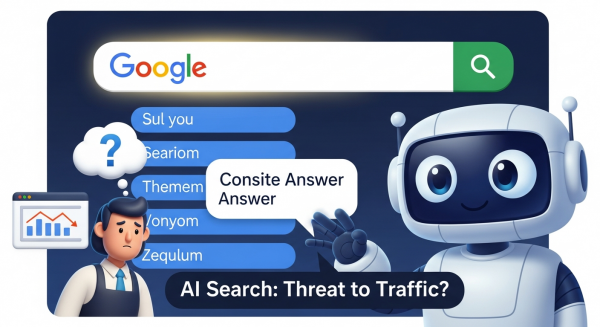
Is Google’s New AI Search Coming for Your Website Traffic? What Small Businesses Need to Know
If you’ve used Google in the last few weeks, you might have noticed something new. Something big. Right at the top of the results page, where you used to see a list of blue links, there’s often a full, detailed answer, written in a conversational tone. This is Google’s new “AI Overview,” and it represents one of the most significant shifts in search engine technology in over a decade.
For small business owners, any change to Google’s formula can feel like a tremor. You’ve worked hard to climb the rankings, optimize your pages, and earn that precious spot on the first page. Now, a friendly AI summary sits above it all. The immediate question on everyone’s mind is a critical one: will people still click through to my website?
It’s a valid concern, but there’s no need to panic. This change is not the end of SEO; it’s an evolution. Understanding what AI Overviews are, how they work, and how to adapt your strategy will not only help you weather this shift but could even open up new opportunities for visibility and growth. Let’s break down what’s happening and what you need to do next.
What Exactly Are Google’s AI Overviews?
In simple terms, AI Overviews are AI-generated snapshots that aim to answer a user’s query directly within the search results page. Instead of just providing a list of links for you to explore, Google’s generative AI synthesizes information from multiple top-ranking web pages to construct a comprehensive summary. You’ll see these summaries appear for a wide range of searches, from “how to fix a leaky faucet” to “what are the best marketing strategies for a local coffee shop?”
This feature is the public-facing evolution of what Google has been testing for the past year under the name “Search Generative Experience” or SGE. After extensive testing, Google has begun rolling it out to a massive audience, a move they officially announced at their recent I/O conference. According to Google’s own statement, the goal is to help people “get more from a single search” by doing the heavy lifting for them.
The AI doesn’t just pull from one source. It looks at various articles, blog posts, and data points, then pieces together a coherent answer, complete with links to the sites it used for information. Think of it as a research assistant who reads the top five articles for you and gives you the executive summary. The convenience for the user is clear, but what does it mean for the businesses that created that original content?
The Big Question: How Will AI Overviews Impact Your Small Business?
Let’s address the elephant in the room. The primary concern is a potential decrease in organic website traffic. If a user gets their answer directly from the AI Overview, their motivation to click on an individual link diminishes. This has sparked widespread discussion about the rise of “zero-click searches.”
The Potential Downside: The Threat of “Zero-Click” Searches
A zero-click search is exactly what it sounds like: a user types a query, gets their answer on the results page, and then leaves without clicking on any website. This is most likely to happen with simple, informational queries. For example, if someone searches for “what is the capital of Vermont?”, the AI can answer “Montpelier” instantly, and the user’s journey ends there.
For businesses that rely on content marketing to attract visitors with “how-to” guides, definitions, or quick facts, this could mean a noticeable dip in traffic. It’s like a potential customer calling your store to ask your hours, and an automated system answers so efficiently that they never have a reason to speak with a person who might have told them about your current sale. While the query was answered, a potential engagement opportunity was lost.
The Unexpected Upside: New Opportunities for Visibility
However, it’s not all doom and gloom. In fact, this shift creates a new, highly-visible placement to aim for: being a cited source within the AI Overview itself. When Google’s AI uses your content to formulate its answer, it will often include a link back to your page. While this might not be a direct click from a traditional blue link, it’s a powerful endorsement.
Being featured in an AI Overview positions your brand as an authority on the topic. It’s a stamp of credibility directly from Google. Furthermore, for more complex, high-intent searches—the kind that lead to actual sales—users will still want to dig deeper. A person searching for “best accounting software for a small business” might read the AI summary, but they will almost certainly want to click through to read detailed reviews, compare features, and look at pricing on the actual provider websites. Clicks for these valuable, bottom-of-the-funnel keywords are unlikely to disappear.
How to Adapt Your SEO Strategy for an AI-Powered World
The core principles of good SEO haven’t changed, but their importance has been amplified. To succeed in the age of AI search, you need to be more strategic and human-centric than ever before. Here are the key areas to focus on right now.
1. Double Down on High-Quality, People-First Content
If an AI is going to use your content, it needs to be the best content available. Generic, surface-level articles won’t cut it. Your content needs to provide genuine value, unique insights, and comprehensive answers that go beyond the obvious. Think about the follow-up questions your customers might have and answer those, too. This is a core principle of our SEO & Content Strategy services. The richer and more helpful your content, the more likely Google’s AI will see it as a premium source worthy of citation.
2. Focus on Expertise, Authoritativeness, and Trustworthiness (E-E-A-T)
Google has been emphasizing E-E-A-T (now with an extra ‘E’ for Experience) for years, and it’s a critical ranking factor. The AI will prioritize sources it deems credible and trustworthy. You can signal your expertise by:
- Showcasing author credentials and creating detailed author bios.
- Including case studies, customer testimonials, and data to back up your claims.
- Making your contact information and company history easy to find.
- Securing positive reviews on third-party platforms.
Building a trustworthy brand is no longer just a good marketing practice; it’s a technical SEO requirement. If you want to dive deeper, Moz offers an excellent guide on what E-E-A-T means and how to implement it.
3. Optimize for Long-Tail and Conversational Keywords
As users get more comfortable with AI, they will start asking it more complex, conversational questions. Your keyword strategy needs to reflect this. Instead of targeting a two-word phrase like “business loans,” focus on the full questions your customers are actually asking.
- Instead of “local bakery,” think “where can I find the best gluten-free birthday cake in Brooklyn?”
- Instead of “SEO services,” think “how can a small retailer improve its local search ranking?”
Creating content that directly answers these long-tail queries makes it much more likely to be featured in an AI Overview and to capture highly qualified traffic from users with a very specific need.
4. Prioritize a Flawless User and Technical Experience
All the great content in the world won’t matter if your website is slow, confusing, or broken on mobile devices. A strong technical foundation is non-negotiable. Google’s AI is less likely to pull information from a site that provides a poor user experience. Ensure your site is fast-loading, mobile-friendly, secure (using HTTPS), and easy to navigate. A robust technical foundation is a crucial part of our comprehensive Website Design Services, because it directly impacts your visibility and credibility.
Beyond SEO: A Holistic Digital Marketing Approach is Key
Finally, this change is a powerful reminder not to put all your eggs in one basket. While SEO remains a vital channel, a healthy business has multiple streams of traffic and leads. This is the perfect time to strengthen your other digital marketing efforts.
Focus on building your email list, which gives you a direct line of communication with your audience that no algorithm change can take away. Nurture an engaged community on the social media platforms where your customers spend their time. Consider using targeted paid advertising to guarantee placement for your most important commercial keywords. Interestingly, exploring how AI Automations for Small Business can streamline these other marketing tasks is a brilliant way to reinvest the time you save.
The digital landscape is always in motion, and Google’s AI Overviews are just the latest wave in a sea of change. By focusing on creating genuinely helpful, high-authority content and building a strong, multi-channel marketing strategy, you won’t just survive this shift—you’ll be positioned to thrive. The fundamentals of good business and marketing still apply: know your audience, solve their problems, and build trust. The technology may change, but that core mission never will.
Navigating these changes can be challenging, but you don’t have to do it alone. If you’re ready to adapt your strategy and turn search evolution into a business opportunity, book a free, no-obligation consultation with our expert team today.