
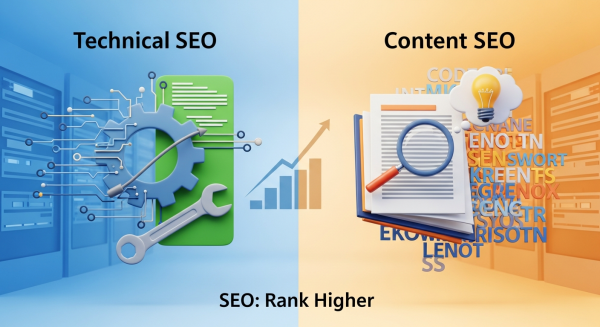
Technical SEO vs. Content SEO: A Small Business Owner’s Guide to Ranking Higher
As a small business owner, you know that visibility is everything. You want your customers to find you easily, and in today’s digital world, that means showing up on the first page of Google. The key to unlocking that prime real estate is Search Engine Optimization (SEO), but the term itself can feel overwhelming. It isn’t a single magic button; it’s a comprehensive strategy with two distinct, yet deeply interconnected, pillars: Technical SEO and Content SEO.
Many business owners focus on one while neglecting the other, wondering why their rankings aren’t improving. Understanding the difference—and more importantly, how they work together—is the secret to building a sustainable online presence that drives real growth. Think of it like building a house. Technical SEO is the strong foundation, the sturdy framework, and the flawless electrical wiring. Content SEO is the beautiful interior design, the comfortable furniture, and the welcoming atmosphere that makes people want to stay. You simply cannot have a successful home without both.
This guide will demystify these two essential components of a winning SEO strategy. We’ll break down what each one entails, why they matter for your business, and how they combine to create a powerful engine for attracting and converting customers.
What is SEO, Really? A Quick Refresher
Before we dive into the specifics, let’s establish a clear, simple definition. Search Engine Optimization (SEO) is the practice of increasing the quantity and quality of traffic to your website through organic (non-paid) search engine results. It’s about signaling to search engines like Google that your website is a credible, valuable, and relevant resource for what your potential customers are looking for.
When you do it right, Google rewards you with higher rankings. This leads to more visibility, more clicks, and ultimately, more business. The process involves making specific improvements to your website’s structure and content. These improvements fall neatly into our two main categories: technical and content.
Understanding Technical SEO: The Foundation of Your Digital Presence
Technical SEO refers to all the optimizations you make to your website and server that help search engine spiders crawl and index your site more effectively. It has nothing to do with the actual content or keywords on your pages. Instead, it’s all about the quality of your website’s infrastructure. A site with a strong technical foundation is fast, secure, and easy for both users and search engine bots to navigate.
Key Components of Technical SEO
While the term “technical” might sound intimidating, the core concepts are straightforward. These are the elements that ensure your website is running like a well-oiled machine.
- Site Speed and Core Web Vitals: In our fast-paced world, patience is thin. If your website takes more than a few seconds to load, visitors will leave. Google knows this, which is why site speed is a critical ranking factor. The search giant measures this using a set of metrics called Core Web Vitals, which assess loading performance, interactivity, and visual stability. A faster site delivers a better user experience, and Google rewards that.
- Mobile-Friendliness: More than half of all web traffic now comes from mobile devices. Google uses “mobile-first indexing,” meaning it primarily looks at the mobile version of your website to determine rankings. A responsive design that looks and works great on any screen size is no longer optional; it’s essential.
- Crawlability and Indexability: For your site to be ranked, search engines first have to find it (crawl) and then add it to their massive database (index). Technical SEO ensures there are no roadblocks. This involves creating an XML sitemap (a map of your website for search engines) and using a file called `robots.txt` to tell bots which pages they should or shouldn’t crawl.
- Site Architecture: A logical, well-organized website structure makes it easy for users to find what they need. It also helps search engines understand the relationship between your pages and which ones are most important. Clear navigation and simple URL structures are hallmarks of good site architecture, a core component of professional website design services.
- Website Security (HTTPS): Security is paramount. An SSL certificate (which enables HTTPS, the “s” standing for secure) encrypts data between your website and your visitors. It’s a trust signal for both users and search engines, and Google has confirmed it as a lightweight ranking signal.
Why Technical SEO Matters for Your Business
Ignoring technical SEO is like building your dream storefront on a crumbling foundation. It doesn’t matter how great your products or services are if the doors are locked, the lights are off, and the floor is unstable. A technically sound website is the bedrock of your entire digital marketing strategy. It improves user experience, builds trust, and makes it possible for all your other marketing efforts to succeed.
Mastering Content SEO: The Voice of Your Brand
If technical SEO is the foundation, content SEO is everything you build on top of it. Content SEO focuses on creating and optimizing the actual information on your website—the words, images, and videos—to attract, engage, and convert your target audience. It’s about providing valuable answers to the questions your potential customers are asking on Google.
Key Components of Content SEO
This is where you directly address your audience’s needs and showcase your expertise. A strong content strategy is what turns a visitor into a customer.
- Keyword Research: This is the cornerstone of any successful content plan. It’s the process of identifying the specific words and phrases your ideal customers use when searching for your products or services. A deep understanding of keyword research helps you create content that directly targets user intent—whether they are looking for information, comparing options, or ready to buy.
- High-Quality, Valuable Content: Google’s primary goal is to provide its users with the best possible answers. To rank well, your content must be original, comprehensive, well-written, and genuinely helpful. This includes your service pages, blog posts, case studies, and FAQs. Each piece should be created to serve a purpose for your audience.
- On-Page SEO Elements: This involves optimizing specific elements on each page to clearly signal its topic to search engines. Key on-page factors include:
- Title Tags: The clickable headline that appears in search results.
- Meta Descriptions: The short summary under the title tag that entices users to click.
- Header Tags (H1, H2, H3): These organize your content into a logical hierarchy, making it easier for people and search engines to read.
- Image Alt Text: A description of an image that helps search engines understand its content and improves accessibility.
- Internal Linking: Linking to other relevant pages on your own website helps users navigate and distributes authority across your site.
- Topical Authority: You can’t just write one blog post and expect to be seen as an expert. Topical authority is about building a deep and wide collection of content around your core business topics. This signals to Google that you are a go-to resource in your industry, which is a key part of any long-term SEO strategy.
Why Content SEO is Crucial for Growth
Great content is what builds relationships with your audience. It establishes your brand as a credible authority, builds trust, and guides potential customers through their buying journey. Without compelling, optimized content, even a technically perfect website is just an empty vessel. It’s the substance that attracts organic traffic and drives your business goals.
The Synergy: Why You Need Both Technical and Content SEO
By now, the connection should be clear: technical and content SEO are two halves of the same whole. They are not competing priorities; they are partners in a successful digital strategy.
Imagine you write the most insightful, helpful blog post in your industry (fantastic content SEO). But your website takes ten seconds to load and isn’t mobile-friendly (poor technical SEO). Most people will never even read your brilliant article. They’ll click away in frustration, and Google will notice, pushing your rankings down.
Conversely, imagine you have a lightning-fast, perfectly secure, and beautifully structured website (flawless technical SEO). But your service pages are thin, your blog is empty, and you aren’t targeting any relevant keywords (poor content SEO). Your website is an empty, high-tech shell. Search engines will have nothing to rank, and users will have no reason to visit.
Success lies in the synergy. Technical SEO paves the way for search engines to find and appreciate your site. Content SEO provides the high-quality substance that makes them want to rank it at the top.
A Modern Twist: How AI Impacts Both SEO Pillars
Artificial intelligence is no longer a futuristic concept; it’s a practical tool that can enhance both sides of your SEO efforts. AI-powered tools can quickly diagnose and suggest fixes for technical issues, from broken links to slow-loading scripts. On the content side, AI can supercharge your keyword research, help generate topic ideas, and even assist in drafting articles. Leveraging AI automations for small business can save time and provide data-driven insights, allowing you to create a more effective and efficient SEO strategy.
In the end, a holistic approach is the only path to sustainable success. Technical SEO and content SEO are not an “either/or” choice. They are the essential, complementary forces that propel your website to the top of the search results, connecting you with the customers who need you most. By investing in both the foundation and the finishings of your digital home, you build an online presence that is not only visible but also valuable and trusted.
Ready to combine technical excellence with compelling content to achieve measurable growth for your business? Book your free, no-obligation consultation with our SEO experts today and discover what a comprehensive strategy can do for you.