
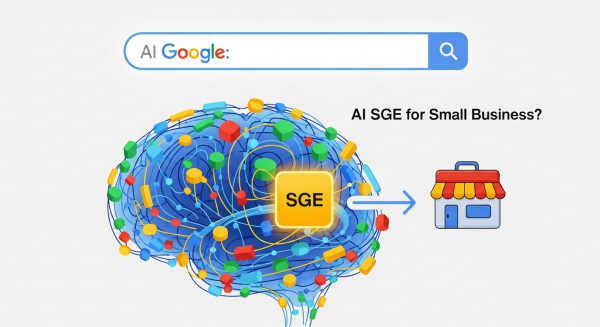
Google’s AI Search is Here: Is Your Small Business Ready for the SGE Revolution?
Take a moment and think about how your customers find you online. For the better part of two decades, the process has been remarkably consistent: they type a question into Google, scan a list of ten blue links, and click on the one that looks most promising. That familiar landscape, the very foundation of digital marketing, is now undergoing its most significant transformation since its inception. The culprit and the catalyst? Artificial Intelligence.
Google is actively rolling out its Search Generative Experience, or SGE. This isn’t just a minor tweak or algorithm update; it’s a fundamental reimagining of the search results page. If you’re a small business owner, this isn’t some far-off tech trend to ignore. It’s happening right now, and it will directly impact your website traffic, lead generation, and ultimately, your bottom line. But don’t panic. With change comes opportunity, and understanding SGE today is the key to thriving tomorrow.
What Exactly is Google’s Search Generative Experience (SGE)?
In the simplest terms, SGE is Google using its advanced AI to provide direct, comprehensive answers to user queries right at the top of the search results. Instead of just giving you a list of links to find the answer yourself, Google now often creates a custom “AI snapshot” that summarizes information from multiple sources, complete with images, links, and follow-up questions.
Think of it like asking a hyper-intelligent research assistant for help. You don’t just get a reading list; you get a synthesized answer. While traditional search results still appear below this AI-generated block, the prime real estate on the page is now dedicated to this new experience. According to research from digital marketing expert Neil Patel, this shift has profound implications for how users interact with search results, and consequently, how businesses need to approach their online visibility.
Why This Is a Game-Changer for Small Businesses
The immediate concern for many business owners is, “If Google answers the question directly, why would anyone need to click on my website?” It’s a valid fear. For simple, informational queries, we will likely see a decrease in click-through rates. If a user can get a quick definition or a simple list without leaving Google, they will.
However, this is not the end of SEO. It’s an evolution. The AI snapshot still pulls its information from websites, and it prominently features links to its sources. The new goal isn’t just to be on page one; it’s to be a cited source within the AI-generated answer. Becoming that trusted source is the new frontier of digital marketing, separating the businesses that adapt from those that get left behind.
How to Adapt Your Digital Marketing for the SGE Era
Thriving in this new AI-powered search environment doesn’t require you to throw out everything you know about digital marketing. In fact, it doubles down on the principles that have always mattered: quality, authority, and user experience. Here’s how to pivot your strategy to win with SGE.
1. Create Genuinely Helpful, People-First Content
The days of writing thin articles stuffed with keywords to trick an algorithm are definitively over. Google’s AI is designed to understand and reward content that demonstrates true expertise and provides real value. This concept is at the heart of what Google calls creating helpful, reliable, people-first content.
- Share Your Unique Expertise: Don’t just regurgitate facts. Write about your first-hand experiences. Create detailed case studies, share customer success stories, and offer insights that can only come from being an expert in your field.
- Answer Complex Questions: Go beyond the simple “what is” queries. Tackle the nuanced, multi-step questions your customers are actually asking. The more comprehensive and insightful your content, the more likely the AI will see it as a valuable resource to cite.
- Prioritize Authenticity: Your brand’s voice and perspective are now a competitive advantage. Let your personality show and build a genuine connection with your audience.
An effective content plan is no longer optional. Our approach to SEO & Content Strategy is built on this very principle: creating authoritative content that establishes you as a leader and directly supports your business goals in this new search landscape.
2. Target Conversational, Long-Tail Keywords
Think about how people talk to voice assistants or AI chatbots. They don’t use robotic keywords; they ask full questions. Your keyword strategy needs to reflect this conversational shift. Instead of targeting a broad term like “landscaping services,” focus on more specific, long-tail phrases your ideal customer would type.
For example, a better target would be: “what is the best low-maintenance landscaping for a small front yard in Arizona?” Content built around answering this specific question is far more likely to be featured in an SGE result than a generic service page. Use tools to find the actual questions people are asking and build your content around providing the best possible answers.
3. Build Your Brand’s Authority and Trust (E-E-A-T)
In an AI-driven world, trust is everything. Google uses a framework it calls E-E-A-T (Experience, Expertise, Authoritativeness, and Trustworthiness) to evaluate the quality of a website. The AI will heavily favor information from sources it deems credible.
How do you build this trust?
- Earn High-Quality Backlinks: Get links to your site from other reputable websites in your industry.
- Encourage Customer Reviews: Positive reviews on Google Business Profile, Yelp, and industry-specific sites send strong trust signals.
- Showcase Your Credentials: Display author bios, certifications, awards, and testimonials prominently on your site.
Every piece of your digital presence should work to reinforce that you are a legitimate, trustworthy expert in your field. A well-designed website is crucial for this. Our Website Design Services focus on creating sites that not only look great but are also structured to build immediate trust with both users and search engines.
4. Don’t Forget the Technical Foundation
Even the best content in the world won’t get noticed if your website is slow, broken, or hard to use on a mobile phone. A fantastic user experience is a prerequisite for success in modern SEO. SGE doesn’t change that; it reinforces it.
Ensure your site is fast-loading, mobile-friendly, and secure. Furthermore, using structured data (like Schema markup) helps Google’s AI understand the context of your content more effectively, increasing the chances of it being featured. As noted by Search Engine Journal, technical SEO and structured data are becoming even more critical for signaling quality to Google’s generative AI.
The Future is Now
The rise of SGE and AI in search is not a distant possibility; it’s the new reality of digital marketing. While it presents new challenges, it also offers a tremendous opportunity for small businesses that are willing to adapt. By focusing on creating genuinely valuable content, building brand authority, and answering your customers’ real questions, you can not only survive this shift but thrive in it. The core principle remains the same: be the best, most helpful answer for your customer, and Google will reward you.
The digital landscape is shifting, but you don’t have to navigate it alone. If you’re ready to future-proof your online presence and turn these changes into a competitive advantage, book your free, no-obligation consultation with our expert team today.