
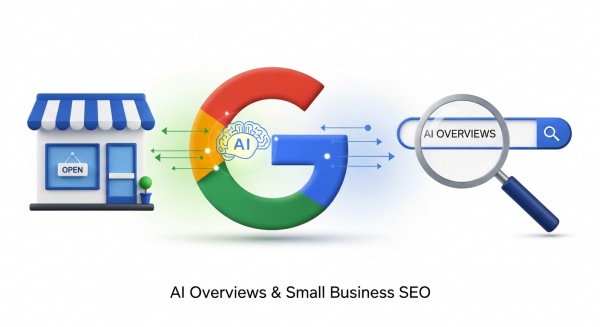
Google’s New AI Overviews Are Here: What This Means for Your Small Business SEO
You may have noticed something different about Google search results lately. Right at the very top, where you used to see a list of blue links, there’s often a new, shaded box providing a detailed, conversational answer to your query. This is Google’s “AI Overview,” and its official rollout marks one of the biggest shifts in search engine behavior in over a decade. For small business owners who rely on Google for visibility and website traffic, this change isn’t just a novelty—it’s a fundamental pivot that requires immediate attention.
For years, the goal of search engine optimization (SEO) was simple: get your website to rank as high as possible on the results page to earn a click. But what happens when Google answers the user’s question directly, potentially eliminating the need for that click? It’s a daunting thought, but it’s not a doomsday scenario. It’s an evolution. Understanding how AI Overviews work and proactively adapting your digital marketing strategy is now critical for survival and success in this new landscape.
What Exactly Are Google’s AI Overviews?
Think of AI Overviews as a supercharged version of the old “featured snippets.” Instead of pulling an answer from a single webpage, Google’s generative AI now synthesizes information from multiple sources across the web to create a comprehensive, easy-to-digest summary. This AI-generated answer appears at the top of the search results page, complete with links to the websites it used as sources.
These overviews are designed to help users get quick, multi-faceted answers to more complex questions. For example, a search like “what are the best durable materials for a patio in a rainy climate?” might trigger an AI Overview that compares wood, composite, and stone, pulling details about cost, maintenance, and longevity from various home improvement blogs and retail sites. The goal, from Google’s perspective, is to provide a better, faster user experience. But for the businesses whose content is being summarized, the implications are profound.
How Will AI Overviews Impact Your Small Business?
The arrival of AI Overviews brings both significant challenges and new opportunities. Ignoring this shift isn’t an option, so let’s break down what it could mean for your website traffic and online visibility.
The Challenge: A Potential Drop in Organic Clicks
The most immediate concern for many small business owners is a potential reduction in website traffic. If a user gets a complete answer directly from the AI Overview, they may have no reason to click through to any of the source websites. This is particularly true for simple, informational queries—the kind that often form the top of the marketing funnel. Industry experts have been discussing this possibility for months, with some analyses suggesting that AI-driven search could significantly reduce clicks to publisher websites.
If your digital marketing strategy relies heavily on attracting users with blog posts that answer basic questions, you might see a dip in visitor numbers. This means every visitor you *do* get becomes even more valuable, placing greater importance on conversion-focused web design.
The Opportunity: Becoming an Authoritative Source
While it’s true that some clicks may disappear, a new, highly valuable position has emerged: being a cited source *within* the AI Overview. When your website is featured as a source, it receives an incredible endorsement directly from Google. The links in these overviews aren’t just blue links lost in a list; they are authoritative citations, positioned as the go-to resources for users who want to dig deeper.
A click from an AI Overview is likely to come from a highly qualified, high-intent user. This person wasn’t satisfied with the summary and is actively seeking more detailed information, making them a much warmer lead than a casual browser. The new goal for small business SEO isn’t just to rank, but to become the trusted source that Google’s AI relies on and recommends.
5 Ways to Adapt Your SEO Strategy for AI-Powered Search
So, how do you position your business to thrive in this new environment? It’s not about finding a magic trick to “beat” the AI. It’s about doubling down on the fundamentals of great content and technical SEO. Here are five actionable steps you can take right now.
1. Create Genuinely Helpful, People-First Content
Google’s core mission has always been to provide users with the best possible information, and its AI is built to find it. This means generic, keyword-stuffed content is more obsolete than ever. Your new focus must be on creating what Google calls helpful, reliable, people-first content. This includes:
- Firsthand Experience: Share unique insights from your professional experience. A plumber writing about fixing a specific type of leak offers more value than a generic article.
- Original Data and Research: Conduct your own surveys, analyze trends, or present case studies. This is information the AI cannot find elsewhere.
- Comprehensive Guides: Don’t just answer a question; explore the topic from every angle, addressing follow-up questions before they’re even asked.
This is the bedrock of any modern SEO & Content Strategy. When your content is truly the best resource on a topic, both humans and AI will recognize it.
2. Target Long-Tail and Complex Questions
AI Overviews are most often triggered by conversational or complex queries, not simple one or two-word searches. This is where small businesses can shine. Think about the very specific, nuanced questions your customers ask you every day. Instead of targeting “landscaping services,” focus on creating content that answers, “what is the most drought-resistant grass for a shady lawn in Texas?”
Use tools like AnswerThePublic or browse forums like Reddit and Quora to find the real-world problems your audience is trying to solve. Creating detailed content around these long-tail keywords makes you a prime candidate for being featured in an AI-generated answer.
3. Master Your Brand’s Authority (E-E-A-T)
Google’s concept of E-E-A-T (Experience, Expertise, Authoritativeness, and Trustworthiness) is now more critical than ever. The AI is programmed to prioritize information from sources it deems credible and trustworthy. You can build your E-E-A-T by:
- Showcasing Author Expertise: Include detailed author bios on your blog posts that highlight their credentials and experience.
- Gathering Social Proof: Encourage customer reviews, feature testimonials, and display case studies prominently on your site.
- Earning Backlinks: Secure mentions and links from other reputable websites in your industry.
Your brand’s overall reputation online is a powerful signal that tells Google’s AI that you are a reliable source of information.
4. Optimize Your Technical and On-Page SEO
While content quality is paramount, the technical foundation of your website still matters immensely. The AI needs to be able to easily find, crawl, and understand your content. Ensure your website is in top shape by:
- Using Structured Data (Schema Markup): This is code that helps search engines understand the context of your content, such as whether it’s a recipe, a review, or an FAQ page.
- Following On-Page SEO Best Practices: Use clear, descriptive title tags, meta descriptions, and header tags (H1, H2, H3) to structure your content logically.
- Ensuring Mobile-Friendliness and Fast Load Times: A poor user experience can hurt your credibility and rankings.
5. Enhance the On-Site Customer Experience
With potentially fewer clicks to go around, you must make every single visit count. When a user does click through to your site from an AI Overview, they are a highly valuable, motivated prospect. Your website must be ready to capture their interest and guide them toward a conversion.
This is where a professional, user-focused approach to Website Design Services becomes a crucial part of your digital marketing strategy. Ensure your site has clear calls to action, intuitive navigation, and compelling content that demonstrates why you are the right choice. Your website is no longer just a source of information; it’s the final destination where you must convert that hard-earned traffic into a tangible business result.
The rise of Google’s AI Overviews is not the end of SEO; it’s the beginning of a new chapter. This shift forces all of us to elevate our game, moving away from chasing rankings and toward building genuine authority and providing undeniable value. By focusing on creating exceptional, human-centered content and ensuring your website offers a seamless user experience, you can turn this massive change into your biggest competitive advantage.
Navigating these changes can be complex, but you don’t have to do it alone. If you’re ready to adapt your strategy and turn search evolution into business growth, book a free consultation with our expert team today.