
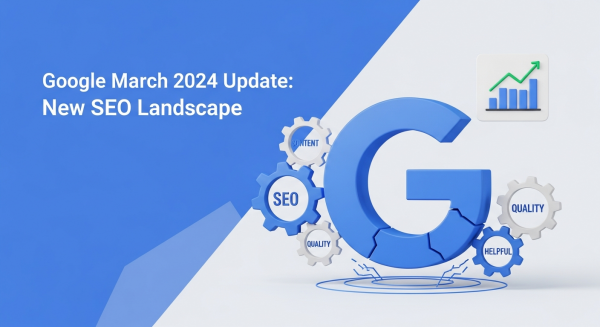
Google’s March 2024 Update: Your Guide to Thriving in the New SEO Landscape
If you’ve noticed some turbulence in your website traffic or keyword rankings lately, you’re not alone. Google has just rolled out one of its most significant updates in years: the March 2024 Core Update, accompanied by a powerful set of new spam policies. While any major algorithm change can feel intimidating, this one represents a massive opportunity for small businesses that are committed to doing things the right way.
Think of it as Google’s big spring cleaning. The goal is to sweep away the low-quality, unhelpful, and spammy content that has been cluttering up search results. In fact, Google expects these changes will reduce unhelpful content by a staggering 40%. For businesses focused on providing genuine value, this isn’t a threat; it’s a chance to shine. Let’s break down what’s happening, why it matters for your bottom line, and the practical steps you can take to not just survive, but thrive.
What Exactly is the Google March 2024 Core Update?
At its heart, a core update is a significant, broad change to Google’s overall ranking algorithm. Unlike smaller tweaks, these updates redefine how Google assesses the quality and relevance of web pages. The March 2024 update is particularly impactful because it’s not just one change; it’s a complex evolution of multiple systems, all focused on a single mission: to better identify and reward content that is genuinely helpful to people.
The biggest shift is that the “Helpful Content System,” which was previously a separate signal that ran alongside the core algorithm, has now been fully integrated into it. This isn’t just technical shuffling. It means that the concept of “helpfulness” is no longer a simple checkmark; it’s woven into the very fabric of how Google ranks every single page on the web. A page is no longer judged on keywords alone, but on whether it provides a satisfying, useful experience for the user.
The New Rules of Engagement: Quality and User Experience Reign Supreme
So, what does Google consider “helpful” content? This is where the long-standing concept of E-E-A-T comes into play. While it might sound like an acronym from a marketing textbook, it’s a simple framework that every business owner should understand:
- Experience: Does the content creator have firsthand, life experience with the topic? For example, a review of a hiking boot written by someone who has actually hiked the Appalachian Trail holds more weight.
- Expertise: Does the author possess the necessary knowledge or skill in the field? An article on small business tax law written by a certified accountant is more valuable than one by a general writer.
- Authoritativeness: Is your website or brand recognized as a go-to source in your industry? This is built over time through consistent, high-quality content and recognition from others.
- Trustworthiness: Can users trust your content? This involves everything from citing sources and having a secure website (HTTPS) to being transparent about who you are.
This update powerfully reinforces that creating content just to rank on Google is a failing strategy. The new mandate is clear: create content for your customers first. When you solve their problems, answer their questions, and demonstrate your genuine expertise, Google’s algorithm is now better equipped than ever to reward you with higher visibility.
Google’s War on Spam: What Tactics Are Being Penalized?
Alongside the core update, Google has sharpened its spam-fighting tools, targeting several manipulative tactics that have been used to game the system. Understanding these helps you know what to avoid and why your high-quality approach is now a competitive advantage.
Scaled Content Abuse
This policy targets the practice of generating massive amounts of unoriginal, low-value content primarily to manipulate search rankings. This is a direct shot at the misuse of AI to churn out hundreds of generic articles that offer no real insight or value. The key takeaway is that whether the content is created by a human, AI, or a combination, if its purpose is to game the system rather than help the user, it’s now considered spam.
Site Reputation Abuse
You may have heard this called “parasite SEO.” This is when a trusted, high-authority website rents out a section of its site to a third party, who then publishes low-quality, spammy content to take advantage of the host site’s good reputation. Google is cracking down on this, ensuring that a website’s reputation is earned by its own content, not “borrowed” to promote unrelated, spammy material. As Search Engine Journal points out, this aims to close a major loophole for spammers.
Expired Domain Abuse
This refers to the black-hat practice of buying an expired domain name—let’s say a respected local bakery that went out of business—and repurposing it with completely unrelated, low-quality content to trick search engines. The new owner hopes the domain’s old authority will give their new, unrelated content a ranking boost. Google is now much better at identifying and devaluing this practice.
Your 5-Step Action Plan to Win in this New SEO Era
Seeing Google talk about de-ranking 40% of the web can be scary, but it’s an incredible opportunity. While your competitors who relied on shortcuts see their traffic plummet, you can rise to the top. Here is your action plan:
- Don’t Panic, Analyze: Algorithm updates take time to fully roll out—this one could take a month. Avoid making knee-jerk reactions. Monitor your Google Analytics and Search Console data. If you see a dip, don’t immediately start deleting pages. Instead, use this as a diagnostic tool to identify which pages may no longer be considered “helpful.”
- Conduct a “Helpfulness” Audit: Go through your key website pages—your homepage, service pages, and top blog posts. Read them from the perspective of your ideal customer. Does this page truly answer their question? Does it solve their problem? Does it showcase your unique experience and expertise? If not, it’s time for a rewrite. Our SEO & Content Strategy services focus on creating this kind of high-value, E-E-A-T driven content.
- Double Down on User Experience (UX): Helpfulness isn’t just about the words on the page. Is your website easy to navigate on a mobile phone? Do pages load quickly? Can a visitor find your contact information in a few seconds? A frustrating user experience sends a strong signal to Google that your site isn’t helpful. A clean, professional, and fast website is non-negotiable. Investing in high-quality Website Design Services is one of the best ways to future-proof your online presence.
- Use AI as an Assistant, Not an Author: Artificial intelligence is a powerful tool for brainstorming ideas, creating outlines, or overcoming writer’s block. However, as this update proves, using AI to simply generate entire articles without significant human oversight is a recipe for disaster. Use it to enhance your team’s efficiency, but ensure every single piece of content is edited, fact-checked, and infused with your authentic brand voice and human experience.
- Focus on Building Real Authority: Stop chasing short-term ranking tricks and start building a long-term brand. Engage with your community on social media, seek out genuine guest posting opportunities on respected industry blogs, and encourage happy customers to leave reviews. These off-site signals build the kind of trust and authority that algorithms are designed to recognize and reward.
The message from Google’s March 2024 Core Update is loud and clear: the future of SEO belongs to businesses that genuinely serve their audience. By prioritizing high-quality, user-focused content and a seamless website experience, you’re not just playing by Google’s new rules—you’re building a more resilient, profitable, and trustworthy business for the long haul.
If you’re ready to turn these seismic shifts into a competitive advantage, our team is here to help you navigate the new landscape. Book a free, no-obligation consultation today and let’s build an SEO strategy that drives real, sustainable growth.