Skip to content
 Unlock Hidden Traffic: A Small Business Guide to Image Search Optimization In the bustling digital marketplace, every click, every view, and every visitor counts. As a small business owner, you’re likely focused on blog content, social media, and your main website pages. But are you overlooking a massive, untapped source of traffic? We’re talking about image search. When a potential customer searches for a product, an idea, or a service, they often turn to Google Images. They’re looking for visual confirmation, inspiration, and information. If your website’s images aren’t optimized, you’re essentially invisible in this critical arena. You’re missing out on engaged, high-intent traffic that could be converting into loyal customers. Optimizing your images for search engines, a practice known as image SEO, is no longer a niche tactic for photographers and e-commerce giants. It’s a fundamental component of a comprehensive digital strategy. The good news? It’s more accessible than you think. This guide will walk you through the essential steps to turn your website’s visuals into powerful traffic-driving assets. Why Image SEO Matters for Your Small Business Before we dive into the “how,” let’s solidify the “why.” Investing time in image optimization delivers tangible returns that go far beyond aesthetics. It’s a strategic move that enhances your overall online presence and contributes directly to your bottom line. Drive More Targeted Traffic to Your Website Google Images is one of the world’s largest search engines. Every day, millions of people use it to discover products, find local services, and learn new things. When your images rank high for relevant terms, each image becomes a direct gateway to your website. This isn’t just any traffic; it’s visually-driven and often has a high purchase intent, especially for businesses in retail, home services, food, and creative industries. Enhance User Experience and Engagement Image SEO is fundamentally about creating a better experience for your visitors. A key part of optimization is compressing images so they load quickly. A slow-loading website is a primary reason visitors leave. According to Google’s own best practices, providing a good page experience is crucial for success in search. Fast-loading, high-quality images keep users engaged, reduce your bounce rate, and signal to search engines that your site is a quality resource. Improve Accessibility for All Users A core tenet of image SEO is the use of “alt text.” This descriptive text serves a dual purpose. It describes the image to search engine crawlers, but more importantly, it makes your website accessible to visually impaired users who rely on screen readers. By making your site inclusive, you not only serve a wider audience but also align with best practices that search engines reward. Boost Your Overall SEO Performance Image optimization doesn’t happen in a vacuum. It directly supports your broader SEO Strategy. Relevant, optimized images make your content more engaging and shareable, which can lead to more backlinks. Faster page speeds and lower bounce rates are significant ranking factors. Essentially, by improving your images, you’re sending a cascade of positive signals to Google about the overall quality and authority of your website. The Foundation: Preparing Your Images for Success Great image SEO starts before you even upload a single file to your website. By establishing a solid preparation process, you make the optimization steps much easier and more effective. Start with High-Quality, Relevant Visuals The best optimization in the world can’t fix a bad image. Always aim to use clear, professional, and original photographs or graphics. While high-quality stock photos have their place, original imagery of your team, your products, or your work in action builds authenticity and trust. Most importantly, ensure every image serves a purpose and is directly relevant to the content on the page. An image of a beach has no place on a page about tax preparation services. Choose the Right File Format You don’t need to be a graphic designer to understand the basics of file formats. Choosing the right one balances quality with file size, which is critical for page speed. JPEG (or JPG): The best choice for photographs and complex images with many colors. It offers excellent compression, meaning you can significantly reduce the file size without a noticeable loss in quality. PNG: Ideal for graphics, logos, and images that require a transparent background. File sizes are typically larger than JPEGs, so use them only when transparency is needed. WebP: A modern format developed by Google that provides superior compression for both photos and graphics. WebP images are significantly smaller than JPEGs and PNGs, leading to faster load times. Most modern web platforms and browsers support it. Compress Images for Lightning-Fast Speed This is arguably one of the most critical steps. Large, uncompressed images are the number one cause of slow websites. A fast-loading site is essential for keeping visitors happy and for ranking well in Google. Before uploading any image, run it through a compression tool. Online tools like TinyPNG are incredibly easy to use; you simply upload your image, and it provides a dramatically smaller version with minimal quality loss. Many website platforms also offer plugins or built-in features that can automate this process. On-Page Image SEO: The Core Optimizations Once your images are prepared and uploaded, it’s time to tell search engines what they’re about. These on-page optimizations are where you communicate context and relevance directly to Google’s crawlers. Craft Descriptive, Keyword-Rich File Names Never upload an image with a generic file name like `IMG_4089.jpg` or `Screenshot-2023-10-26.png`. The file name is your first and most direct opportunity to tell Google what the image depicts. Rename the file on your computer *before* you upload it. Be descriptive: Clearly describe the subject of the image. Use keywords naturally: Include your target keyword for the page if it’s relevant. Use hyphens: Separate words with hyphens, not underscores or spaces. Example: Instead of `photo1.jpg`, use `custom-kitchen-remodel-white-marble-island.jpg`. Write Compelling and Accurate Alt Text Alt text (alternative text) is the most important on-page ranking factor for images. It’s a short, written description of an image that
 Navigating the New Google: A Small Business Guide to AI Overviews If you’ve used Google in the last few weeks, you’ve probably noticed a seismic shift in how it presents information. That big, bold, AI-generated summary at the very top of the page? That’s Google’s new “AI Overview,” and it’s not just a test anymore—it’s the new reality of search. For small business owners, this isn’t just a cosmetic change; it’s a fundamental alteration of the digital landscape we’ve spent years learning to navigate. The sudden rollout has sparked a massive conversation among marketers and business owners. What does it mean for website traffic? How does it affect your ranking? Is SEO as we know it dead? The short answer is no, but it is evolving faster than ever. Understanding this change is the first step toward turning a potential disruption into a powerful new opportunity for growth. What Exactly Are Google’s AI Overviews? Think of AI Overviews as Google’s attempt to be your instant research assistant. Instead of just giving you a list of ten blue links and letting you do the work of piecing together the information, Google’s AI now does the synthesis for you. It scans the top-ranking web pages, pulls out what it considers the most relevant information for your query, and presents it in a conversational summary right at the top of the results. These overviews are designed to answer complex, multi-step questions directly. For example, instead of searching for “best hiking boots” and then “easy trails near me,” you could ask, “what are the best hiking boots for easy trails near me?” The AI Overview would aim to answer that entire query in one neat package, often including links to the products and places it mentions. From Google’s perspective, this is about improving the user experience by providing faster, more direct answers. For businesses, however, it means the battle for visibility has a new, formidable front line. Getting a user to click through to your website just got a little bit harder. How Will This Impact Your Small Business? The arrival of AI Overviews brings both a significant challenge and a unique opportunity. How it affects your business will depend largely on how you adapt your digital marketing strategy. The Challenge: A Potential Dip in Organic Traffic The most immediate concern for many businesses is the potential loss of organic website traffic. For years, the goal of SEO has been to rank on the first page to earn a click. Now, if the AI Overview answers a user’s question satisfactorily, they may have no reason to scroll down and click on any of the individual website links. This phenomenon, often called “zero-click searches,” is something marketers have been watching for years, and AI Overviews are its most powerful evolution yet. If your business model relies on ad revenue from high-traffic blog posts or generating leads from informational content, you may feel this pinch most acutely. The top of the funnel just got wider, and a lot more of the activity is happening directly on Google’s results page. The Opportunity: Becoming the Cited Authority On the flip side, being featured in an AI Overview is like achieving a new, supercharged “Position Zero.” When Google’s AI cites your website as a source for its summary, it places your brand and a link to your page directly within the answer. This is an incredibly powerful endorsement. It positions your business as a trusted authority on the topic in a way that even a number one ranking couldn’t before. For a small business, being the go-to source cited by Google’s AI can dramatically boost brand recognition and credibility. While it might not always result in a direct click, that top-level exposure can lead to more direct searches for your brand name later and build a level of trust that pays dividends over the long term. How to Adapt Your SEO Strategy for an AI-Powered World So, how do you navigate this new terrain? The fundamentals of good marketing remain the same, but the tactical execution of your SEO needs a refresh. It’s no longer just about keywords and backlinks; it’s about becoming the most trustworthy, comprehensive, and helpful answer. Double Down on High-Quality, Authoritative Content This has always been important, but now it’s non-negotiable. Google’s AI is built to find and synthesize information from credible sources. To be one of those sources, your content must be exceptional. This is where Google’s concept of E-E-A-T (Experience, Expertise, Authoritativeness, and Trustworthiness) becomes paramount. You need to prove you are an expert in your field. This means creating content that is well-researched, detailed, accurate, and demonstrates your first-hand experience. As expert analysis of E-E-A-T highlights, showcasing real-world experience is now a critical ranking factor that AI looks for. Embrace Conversational, Long-Tail Keywords AI Overviews are triggered by natural language questions, not just two- or three-word search terms. Your content strategy must reflect this. Think about the actual questions your customers ask. Instead of targeting “landscaping services,” target “how often should I water my lawn in the summer in Texas?” Create blog posts, FAQ pages, and service descriptions that directly answer these specific, conversational queries. Our SEO & Content Strategy services focus on identifying these high-intent questions to capture the exact audience you’re looking for. Prioritize Technical SEO and Structured Data Structured data, or Schema markup, is like adding labels to the content on your website. It’s code that doesn’t change how your site looks to a human, but it explicitly tells search engines what your content is about. For example, you can label your business address, phone number, product prices, and customer reviews. This makes it incredibly easy for Google’s AI to parse your information accurately and pull it into an AI Overview. According to guides on structured data for marketers, this is one of the most effective ways to help search engines understand your content’s context, which is crucial for getting featured in rich results and AI summaries. Build
 Work Smarter, Not Harder: How to Speed Up Your SEO Workflow with AI Search Engine Optimization (SEO) is one of the most powerful ways to drive consistent, high-quality traffic to your website. But let’s be honest: it can also be incredibly time-consuming. Between keyword research, content creation, technical audits, and link building, a comprehensive SEO strategy can feel like a full-time job. For small business owners juggling a dozen other responsibilities, it’s often the first marketing task to be pushed aside. What if you could cut down the time spent on tedious SEO tasks by half, or even more, while achieving better results? That’s not a far-fetched dream; it’s the reality made possible by Artificial Intelligence (AI). AI-powered tools are revolutionizing the digital marketing landscape, acting as intelligent assistants that automate repetitive work, uncover deep insights, and empower businesses like yours to compete on a larger scale. This article will explore how you can integrate AI into your SEO workflow to save time, make smarter decisions, and ultimately, drive more growth. A Quick Primer: What Exactly is AI for SEO? When we talk about “AI for SEO,” we’re not talking about robots taking over your marketing department. Instead, think of AI as a suite of incredibly smart software designed to process vast amounts of data at a speed no human ever could. These tools use concepts like machine learning and natural language processing (NLP) to understand patterns, predict trends, and execute tasks based on that analysis. In simple terms, AI helps you answer critical SEO questions faster and with more accuracy: What are my customers actually searching for? What keywords should I target to get the most valuable traffic? How can I create content that ranks higher than my competitors? Are there technical issues on my website that are hurting my rankings? You don’t need to be a data scientist to benefit from these advancements. Modern AI SEO tools are built with user-friendly interfaces, transforming complex data into actionable recommendations that anyone can understand. It’s about enhancing human expertise, not replacing it. Revolutionize Your Keyword Research with AI Keyword research is the foundation of any successful SEO Strategy. Traditionally, this process involves hours of brainstorming, spreadsheet analysis, and manually sifting through data. AI completely transforms this process from a manual slog into a strategic, data-driven activity. Find Untapped Opportunities in Minutes AI tools can analyze millions of search queries in the blink of an eye to uncover keywords you might never have found on your own. They excel at identifying long-tail keywords—longer, more specific phrases that often have lower competition and higher conversion rates. For example, instead of just targeting “plumber,” an AI tool might suggest “emergency burst pipe repair in downtown.” Furthermore, AI can group thousands of related keywords into thematic clusters. This helps you build out topic authority by creating comprehensive pillar pages and supporting blog posts, signaling to Google that you’re an expert in your field. This level of analysis, as detailed by experts at authoritative sources like Moz, is crucial for a modern SEO approach. Analyze Competitor Strategies at Scale Wondering what keywords are driving traffic to your competitors? AI can automate this entire process. These tools crawl your competitors’ websites and provide a detailed report on the exact keywords they rank for, the pages that bring in the most traffic, and, most importantly, the “keyword gaps.” These are valuable keywords your competitors are ranking for that you currently are not, presenting a clear and immediate opportunity to capture more market share. Accelerate Content Creation and Optimization Creating a steady stream of high-quality, SEO-optimized content is often the biggest hurdle for small businesses. AI can serve as your creative partner and optimization specialist, dramatically speeding up the entire content lifecycle from ideation to publication. Generate Data-Driven Content Briefs Instead of guessing what your content should include, AI tools can create a detailed blueprint for success. By analyzing the top-ranking pages for your target keyword, AI can generate a comprehensive content brief that includes: An ideal word count range. A list of essential subheadings (H2s, H3s) to include. Important related keywords and topics to cover. Frequently asked questions your audience is searching for. Starting with this data-driven outline ensures your content is relevant and thorough from the very beginning, significantly increasing its chances of ranking well. Assist in Writing and Optimizing Drafts AI writing assistants can help you overcome writer’s block by generating initial drafts, rephrasing sentences for clarity, or expanding on a simple idea. While AI-generated text should never be published without a human touch, it’s an incredible tool for getting first drafts done quickly. The real power comes from human editing—where you inject your brand’s unique voice, expertise, and real-world examples. Once you have a draft, AI optimization tools can score its on-page SEO in real-time. They compare your text to top competitors and suggest specific improvements, such as adding relevant keywords, improving readability, and strengthening your internal linking structure. This process takes the guesswork out of optimization, ensuring every piece of content you publish is primed for search engine success. For small businesses seeking a comprehensive plan, we offer specialized AI Automations for Small Business to integrate these efficiencies seamlessly. Simplify Technical SEO with AI-Powered Audits Technical SEO—the process of optimizing your website’s backend infrastructure for search engines—can be the most intimidating part of SEO. It often involves complex issues that can severely impact your rankings if left unchecked. AI-powered auditing tools make diagnosing and fixing these problems more accessible than ever. Automate Site Crawling and Issue Detection An AI-powered site crawler can scan every single page of your website in minutes, identifying hundreds of potential technical issues. These tools go beyond finding simple broken links; they can detect more complex problems like: Slow page load speeds affecting your Core Web Vitals. Improperly implemented redirects or canonical tags that cause duplicate content issues. Missing image alt text or poorly structured data that harms accessibility and crawling. Mobile usability problems that can cause Google
 Google’s Big Shake-Up: What the March 2024 Core Update Means for Your Business If you’re a business owner, you’ve probably felt that little jolt of anxiety when you hear the words “Google update.” It’s like the weather changing without warning. One day you’re enjoying steady website traffic, and the next, you’re wondering where all your visitors went. Well, Google has just rolled out one of its most significant updates in years, the March 2024 Core Update, and it’s causing some serious waves. But here’s the good news: this isn’t a reason to panic. It’s an opportunity. Google is making a clear statement about what it values, and it aligns perfectly with what great businesses have been doing all along—providing real, tangible value to their customers. In this article, we’ll break down exactly what this update is, why it matters for your bottom line, and the practical steps you can take to ensure your business not only survives but thrives in this new landscape. What Exactly Is the March 2024 Google Core Update? Think of this update less as a single tweak and more as a fundamental renovation of how Google evaluates websites. For years, Google has been on a mission to clean up its search results, pushing down low-quality, unhelpful pages and elevating content that genuinely helps users. The March 2024 update is a major leap forward in that mission. According to Google’s official announcement, this update is more complex than previous ones. It involves changes to several core systems and the introduction of brand-new spam policies. The primary goal is to reduce the amount of unoriginal and unsatisfying content in search results by a whopping 40%. In simple terms, Google is getting much, much better at telling the difference between content created to genuinely help a person and content created just to rank on a search engine. This isn’t about penalizing websites. It’s about rewarding the best ones. If your online presence is built on a foundation of authentic expertise and a customer-first mentality, this update could be the best thing that’s happened to your business all year. The Two Pillars of This Update: Helpful Content and New Spam Policies To really understand the impact, it’s helpful to look at the two main components of this change. Both are aimed at the same target—low-value content—but they approach it from different angles. Pillar 1: A Stronger-Than-Ever Focus on “Helpful Content” You may have heard of Google’s “Helpful Content System” before. It was a separate signal Google used to evaluate pages. Now, it has been fully integrated into the main core ranking algorithm. This is a huge deal. It means that the “helpfulness” of your content is no longer just one factor among many; it’s a fundamental part of how Google sees your entire website. So, what does Google consider “helpful”? It boils down to content that demonstrates strong E-E-A-T: Experience: Does the content come from someone with real, first-hand experience on the topic? A recipe from a professional chef is more valuable than one from a random content farm. Expertise: Does the author have deep knowledge and skill in the subject matter? Authoritativeness: Is your website or brand a go-to source for this topic? Are you recognized as a leader in your field? Trustworthiness: Can users trust your content? Is it accurate, secure, and transparent? Content that lacks these qualities is now at a much higher risk of being demoted. This includes thin, superficial articles, pages stuffed with keywords that read unnaturally, and content that promises an answer but never delivers. Creating truly valuable articles is a cornerstone of any effective SEO & Content Strategy, and Google is now rewarding it more directly than ever. Pillar 2: A Major Crackdown on Spammy Tactics Alongside the focus on helpfulness, Google released new spam policies targeting specific manipulative tactics that some have used to game the system. As experts at Search Engine Journal note, these policies are designed to close loopholes that have frustrated both users and ethical marketers for years. Here are the three main areas of focus: Scaled Content Abuse: This targets the practice of generating massive numbers of pages with the primary goal of manipulating search rankings, not helping users. This is often done with AI automation, but it can be done with human-generated content, too. The key here is intent. Using AI to help you write a great article is fine; using it to churn out hundreds of low-quality, generic pages is not. Expired Domain Abuse: This is the practice of buying expired domain names and repurposing them for a completely unrelated topic, just to take advantage of the old site’s “link equity” or authority. For example, buying an expired university’s website and turning it into a casino review site. Google now considers this spam. Site Reputation Abuse: Sometimes called “parasite SEO,” this happens when a trusted website rents out a section or subdomain to a third party that then posts low-quality or spammy content. The third party is essentially “hitching a ride” on the main site’s good reputation. Google is putting a stop to this. For most small business owners, you’re likely not engaging in these black-hat tactics. But it’s important to know what they are, as it demonstrates Google’s commitment to cleaning house and rewarding authenticity. So, What Should a Small Business Owner Do Right Now? Seeing all this information can be overwhelming. Let’s translate it into a clear, actionable game plan for your business. The focus should be on building a resilient, long-term digital presence that can withstand any algorithm update. Don’t Panic. Audit Your Website. First, take a deep breath. Algorithm updates are a normal part of the digital world. Instead of reacting with fear, react with curiosity. Start by looking at your key pages—your homepage, your main service pages, and your most popular blog posts. Ask yourself these honest questions: Does this page clearly solve a problem or answer a question for my ideal customer? Does it showcase our unique expertise and
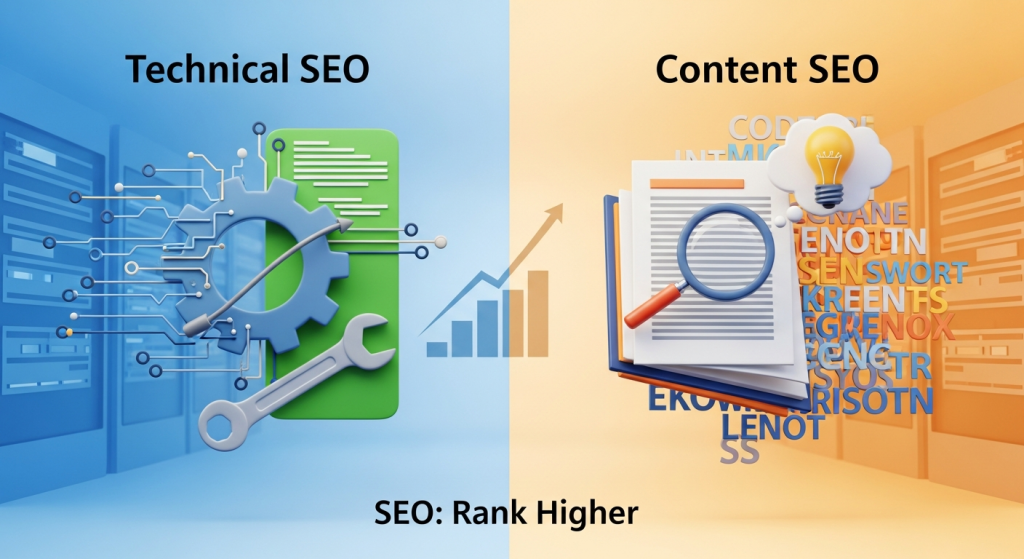 Technical SEO vs. Content SEO: A Small Business Owner’s Guide to Ranking Higher As a small business owner, you know that visibility is everything. You want your customers to find you easily, and in today’s digital world, that means showing up on the first page of Google. The key to unlocking that prime real estate is Search Engine Optimization (SEO), but the term itself can feel overwhelming. It isn’t a single magic button; it’s a comprehensive strategy with two distinct, yet deeply interconnected, pillars: Technical SEO and Content SEO. Many business owners focus on one while neglecting the other, wondering why their rankings aren’t improving. Understanding the difference—and more importantly, how they work together—is the secret to building a sustainable online presence that drives real growth. Think of it like building a house. Technical SEO is the strong foundation, the sturdy framework, and the flawless electrical wiring. Content SEO is the beautiful interior design, the comfortable furniture, and the welcoming atmosphere that makes people want to stay. You simply cannot have a successful home without both. This guide will demystify these two essential components of a winning SEO strategy. We’ll break down what each one entails, why they matter for your business, and how they combine to create a powerful engine for attracting and converting customers. What is SEO, Really? A Quick Refresher Before we dive into the specifics, let’s establish a clear, simple definition. Search Engine Optimization (SEO) is the practice of increasing the quantity and quality of traffic to your website through organic (non-paid) search engine results. It’s about signaling to search engines like Google that your website is a credible, valuable, and relevant resource for what your potential customers are looking for. When you do it right, Google rewards you with higher rankings. This leads to more visibility, more clicks, and ultimately, more business. The process involves making specific improvements to your website’s structure and content. These improvements fall neatly into our two main categories: technical and content. Understanding Technical SEO: The Foundation of Your Digital Presence Technical SEO refers to all the optimizations you make to your website and server that help search engine spiders crawl and index your site more effectively. It has nothing to do with the actual content or keywords on your pages. Instead, it’s all about the quality of your website’s infrastructure. A site with a strong technical foundation is fast, secure, and easy for both users and search engine bots to navigate. Key Components of Technical SEO While the term “technical” might sound intimidating, the core concepts are straightforward. These are the elements that ensure your website is running like a well-oiled machine. Site Speed and Core Web Vitals: In our fast-paced world, patience is thin. If your website takes more than a few seconds to load, visitors will leave. Google knows this, which is why site speed is a critical ranking factor. The search giant measures this using a set of metrics called Core Web Vitals, which assess loading performance, interactivity, and visual stability. A faster site delivers a better user experience, and Google rewards that. Mobile-Friendliness: More than half of all web traffic now comes from mobile devices. Google uses “mobile-first indexing,” meaning it primarily looks at the mobile version of your website to determine rankings. A responsive design that looks and works great on any screen size is no longer optional; it’s essential. Crawlability and Indexability: For your site to be ranked, search engines first have to find it (crawl) and then add it to their massive database (index). Technical SEO ensures there are no roadblocks. This involves creating an XML sitemap (a map of your website for search engines) and using a file called `robots.txt` to tell bots which pages they should or shouldn’t crawl. Site Architecture: A logical, well-organized website structure makes it easy for users to find what they need. It also helps search engines understand the relationship between your pages and which ones are most important. Clear navigation and simple URL structures are hallmarks of good site architecture, a core component of professional website design services. Website Security (HTTPS): Security is paramount. An SSL certificate (which enables HTTPS, the “s” standing for secure) encrypts data between your website and your visitors. It’s a trust signal for both users and search engines, and Google has confirmed it as a lightweight ranking signal. Why Technical SEO Matters for Your Business Ignoring technical SEO is like building your dream storefront on a crumbling foundation. It doesn’t matter how great your products or services are if the doors are locked, the lights are off, and the floor is unstable. A technically sound website is the bedrock of your entire digital marketing strategy. It improves user experience, builds trust, and makes it possible for all your other marketing efforts to succeed. Mastering Content SEO: The Voice of Your Brand If technical SEO is the foundation, content SEO is everything you build on top of it. Content SEO focuses on creating and optimizing the actual information on your website—the words, images, and videos—to attract, engage, and convert your target audience. It’s about providing valuable answers to the questions your potential customers are asking on Google. Key Components of Content SEO This is where you directly address your audience’s needs and showcase your expertise. A strong content strategy is what turns a visitor into a customer. Keyword Research: This is the cornerstone of any successful content plan. It’s the process of identifying the specific words and phrases your ideal customers use when searching for your products or services. A deep understanding of keyword research helps you create content that directly targets user intent—whether they are looking for information, comparing options, or ready to buy. High-Quality, Valuable Content: Google’s primary goal is to provide its users with the best possible answers. To rank well, your content must be original, comprehensive, well-written, and genuinely helpful. This includes your service pages, blog posts, case studies, and FAQs. Each piece should be created to
 The New Face of Google Search: How to Adapt Your SEO for AI Overviews Take a look at a Google search result page today. Now, try to remember what it looked like a month ago. See a difference? There’s a good chance you do. Google is in the middle of one of its most significant transformations in years, and it’s all powered by artificial intelligence. The new star of the show is “AI Overviews,” a feature that is fundamentally changing how users find information and, consequently, how your small business gets found. For years, the goal has been simple: get to the top of the ten blue links. But what happens when the top spot is no longer a link, but a complete, AI-generated answer? It’s a question that’s causing a lot of anxiety for business owners, and for good reason. This shift isn’t a distant-future concept; it’s happening right now, rolling out to millions of users. But don’t panic. Change always brings opportunity. Understanding this new landscape is the first step toward not just surviving, but thriving. In this article, we’ll break down exactly what Google’s AI Overviews are, explore the challenges and opportunities they present, and give you a clear, actionable roadmap to adapt your digital marketing strategy for this new era of search. What Exactly Are Google’s AI Overviews? Think of AI Overviews as a super-smart concierge at the top of the search results. Instead of just giving you a list of websites to visit for an answer, Google’s AI now reads, synthesizes, and summarizes information from multiple high-ranking pages to create a single, comprehensive answer directly on the results page. You’ll see a conversational paragraph, often with bullet points or steps, and links to the sources it used for the information. This feature, powered by Google’s advanced Gemini AI model, is designed to satisfy user queries faster and more efficiently. For a simple question like “How to bake a chocolate cake?” the AI Overview might provide a full ingredient list and step-by-step instructions, pulling details from several different recipe websites. As reported from Google’s recent I/O conference, this is part of a larger vision to make search more intuitive and helpful. The key takeaway is this: Google is trying to answer the user’s question without them needing to click away from Google at all. This has massive implications for your website traffic and overall online visibility. The Big Question: Friend or Foe for Your Small Business? It’s natural to see this change and immediately focus on the negatives. And to be fair, there are some real challenges to consider. However, a balanced view reveals significant opportunities as well. Potential Challenges of AI Overviews Reduced Click-Through-Rate (CTR): This is the biggest concern. If Google answers the user’s question directly, they have less reason to click on your website. This could lead to a significant drop in organic traffic, even if you’re “ranking” well enough to be used as a source. Increased Competition for a “Source” Spot: The ten blue links offered ten chances to get a click. The AI Overview might only cite three or four sources. The competition to be one of those cited sources is going to be incredibly fierce. Risk of Misinterpretation: AI is powerful, but not perfect. There’s a chance the AI could misinterpret the context of your content, presenting inaccurate information to users and attributing it to you. The Hidden Opportunities Unprecedented Brand Authority: Imagine your business being cited as a key source in an AI Overview. This is a powerful endorsement from Google itself. It positions your brand as a trusted authority in your field, which can build credibility faster than a traditional number-one ranking. Visibility for Complex Queries: For nuanced or complex topics that can’t be summed up in a short paragraph, users will still need to click through for a deeper dive. If your content is comprehensive and provides that depth, you can capture highly qualified traffic. New Avenues for Discovery: Being featured can introduce your brand to new audiences who might not have clicked on your link otherwise. It’s a new, high-visibility placement that can act as a powerful form of brand awareness. How to Adapt Your SEO Strategy for an AI-Powered World The game has changed, but the foundational principles of good marketing have not. The goal is still to be the most helpful, authoritative, and trustworthy answer for your potential customers. Here’s how you can adjust your small business SEO to win in the age of AI. 1. Double Down on Genuinely Helpful, People-First Content This has never been more critical. Google’s entire system, including its AI, is being trained to recognize and reward content that is created for humans, not for search engine robots. Vague, generic, or AI-spun articles won’t cut it. Your content needs to demonstrate real-world experience and deep expertise. This directly aligns with Google’s long-standing guidance on creating helpful, reliable content. Ask yourself: Does my content answer the user’s question completely and thoroughly? Does it offer a unique perspective, original data, or expert insight they can’t find elsewhere? Is it well-written, engaging, and easy to understand? Your goal is to become the definitive source on a topic. Crafting this kind of high-value content is the cornerstone of any modern SEO & Content Strategy that aims for long-term success. 2. Optimize for Conversational and Long-Tail Keywords How do people talk to AI assistants like Siri or Alexa? They ask full questions. This same behavior is translating to search. Instead of typing “best running shoes,” a user might now ask, “What are the best running shoes for a beginner with flat feet?” Your content needs to answer these specific, conversational, long-tail questions. Use tools like Google’s “People Also Ask” feature, AnswerThePublic, or even browse forums like Reddit and Quora to understand the exact questions your audience is asking. Then, create dedicated content—or sections within your existing content—that answers them directly and clearly. 3. Embrace Structured Data (Schema Markup) If you want an AI
 How to Create SEO-Optimized Landing Pages That Convert In the world of digital marketing, a landing page is your digital handshake, your sales pitch, and your closing argument all rolled into one. It’s a dedicated, standalone page created specifically for a marketing or advertising campaign. Its sole purpose is to convert visitors into leads or customers. But here’s the problem many businesses face: you can have the most beautifully designed page in the world, but if no one can find it, it’s not doing its job. That’s where Search Engine Optimization (SEO) comes in. By optimizing your landing pages for search engines, you don’t just wait for paid traffic; you attract a steady stream of high-intent, organic visitors who are actively searching for your solution. An SEO-optimized landing page works harder for you, driving qualified traffic, building brand authority, and ultimately, boosting your bottom line. This comprehensive guide will walk you through the essential steps to create landing pages that not only rank well on Google but also persuade visitors to take action. The Foundation: Keyword Research and User Intent Before you write a single word or choose a color palette, you must understand who you’re trying to reach and what they’re looking for. This foundational step involves deep-diving into keyword research and deciphering user intent—the “why” behind a search query. Finding the Right Keywords Keywords are the bridge between a user’s problem and your solution. Targeting the right ones ensures your landing page appears in front of a relevant audience. Instead of guessing, use tools like Google Keyword Planner, Ahrefs, or Semrush to identify terms your potential customers are using. Focus on “long-tail keywords”—phrases of three or more words that are highly specific. For example, instead of targeting the broad term “landscaping,” a more effective long-tail keyword might be “drought-tolerant garden design Austin.” These terms have lower search volume but much higher conversion potential because they signal a user who is further along in the buying journey. Understanding User Intent Once you have your keywords, you need to understand the intent behind them. Are users looking to buy something (transactional intent), find information (informational intent), or navigate to a specific website (navigational intent)? Your landing page content must align perfectly with this intent. If someone searches for “best running shoes for flat feet,” they are likely looking for comparisons and recommendations, not just a product page. Your landing page must satisfy that informational need before it can push for a sale. A solid SEO Strategy always begins with a deep understanding of your audience’s intent. On-Page SEO Essentials for Landing Pages On-page SEO refers to the practice of optimizing individual web pages to rank higher and earn more relevant traffic. For landing pages, these elements are crucial for both search engine crawlers and human visitors. Crafting a Compelling Headline and Title Tag Your headline is the first thing a visitor sees. It needs to be captivating, clear, and include your primary keyword. It should promise a solution to the visitor’s problem. Equally important is the title tag, the headline that appears in the browser tab and on search engine results pages (SERPs). It’s a major ranking factor. A great title tag is concise (under 60 characters), includes your primary keyword, and entices users to click. For a deep dive into crafting effective title tags, check out this excellent guide from the experts at Moz. Writing High-Converting, SEO-Friendly Copy Your landing page copy needs to do double duty: appeal to search engines and persuade people. Here’s how to strike that balance: Natural Keyword Integration: Weave your primary and secondary keywords into your headlines, subheadings, and body copy. Avoid “keyword stuffing,” which is outdated and can harm your rankings. The language should flow naturally and remain customer-focused. Benefit-Oriented Language: Don’t just list features; explain the benefits. How will your product or service make the customer’s life better? Use clear, persuasive language that speaks directly to their pain points. Scannable Structure: Most people don’t read web pages; they scan them. Use short paragraphs, bold text, bullet points, and plenty of white space to make your content easy to digest. Optimizing URLs and Meta Descriptions A clean, descriptive URL helps both users and search engines understand what your page is about. Keep it short, and include your primary keyword. For example: `yourwebsite.com/services/emergency-plumbing-repair` is much better than `yourwebsite.com/page-id-123`. The meta description is the short blurb of text that appears under your title tag in search results. While not a direct ranking factor, a compelling meta description significantly impacts click-through rates. It should be under 160 characters, include your keyword, and present a clear value proposition that makes users want to learn more. The Power of Visuals (and Image SEO) High-quality images, videos, and graphics can dramatically increase engagement and conversion rates. However, unoptimized media files can slow your page down, hurting your SEO. Compress your images to reduce file size without sacrificing quality. Most importantly, use descriptive “alt text” for every image. Alt text helps search engines understand the image’s content and makes your page accessible to visually impaired users. Technical SEO for Peak Performance A landing page can have perfect copy and beautiful design, but if it’s slow or broken, it will fail. Technical SEO ensures your page is fast, accessible, and easily crawled by search engines. Page Speed Matters More Than You Think In our fast-paced world, patience is thin. A slow-loading page is a primary reason for high bounce rates. Google has confirmed that page speed is a critical ranking factor for both desktop and mobile searches. Use tools like Google’s PageSpeed Insights to test your landing page and identify opportunities for improvement, such as compressing images, leveraging browser caching, and minimizing code. Mobile-First Design is Non-Negotiable The majority of web traffic now comes from mobile devices. Google primarily uses the mobile version of a site for indexing and ranking (this is called mobile-first indexing). Your landing page must be fully responsive, meaning it looks and functions perfectly on any
 The Future of Google Search Is Here: How to Win with AI Overviews Take a moment and think about how your customers find you. For years, the answer has been simple: they type a question into Google, scan a list of ten blue links, and click on the most promising one. That familiar process, the bedrock of digital marketing for over two decades, is now undergoing its most significant transformation ever. Google has officially started rolling out “AI Overviews” to all users, and it’s changing the game for every small business with a website. If you’re feeling a little nervous, you’re not alone. Change can be intimidating, especially when it impacts your bottom line. But here’s the good news: this shift also presents a massive opportunity for businesses that are ready to adapt. This isn’t about fighting a new technology; it’s about understanding it and using it to your advantage. In this article, we’ll break down exactly what AI Overviews are, what they mean for your online visibility, and provide actionable steps you can take today to ensure your business continues to thrive in the new era of search. What Are Google’s AI Overviews and Why Do They Matter? In simple terms, an AI Overview is a conversational, AI-generated summary that appears at the very top of the Google search results page for many queries. Instead of just giving you a list of websites, Google’s AI now reads, understands, and synthesizes information from multiple top-ranking pages to provide a direct, comprehensive answer to the user’s question. Imagine you’re looking for “best drought-resistant plants for a sunny garden.” In the past, you’d get a list of articles from gardening blogs and nurseries. Now, you’re likely to see an AI Overview first, listing several plants with brief descriptions, all neatly summarized in a single box. It’s convenient for the user, but it fundamentally changes the dynamic for businesses. This matters immensely because that prime real estate at the top of the page used to be the coveted “position one” that everyone fought for. Now, that position is often occupied by an AI-generated answer. This means the traditional organic search results—the blue links to your website—get pushed further down the page, potentially reducing the number of people who click through to your site. The Big Question: A Threat or an Opportunity for Your Business? It’s natural to see this as a threat. The fear of the “zero-click search,” where a user gets their answer from the AI Overview and never visits a website, is very real. For businesses that rely heavily on traffic from informational blog posts, this could lead to a noticeable drop in visitors. However, viewing it only as a threat is shortsighted. The real story is more nuanced. The Potential Threat: A Drop in Web Traffic For simple, fact-based questions, AI Overviews are incredibly efficient. Queries like “how tall is the Eiffel Tower” or “what is the capital of Australia” can be answered completely by the AI, leaving little reason for a user to click a link. If a significant part of your digital marketing strategy relies on attracting users with this type of top-of-funnel informational content, you may need to rethink your approach. The value of ranking for these simple queries is likely to decrease as users get their answers directly on the search page. The Hidden Opportunity: Becoming the Source of Truth Here’s where the mindset shift is critical. Where does Google’s AI get its information? It gets it from high-quality, trustworthy websites—websites like yours. The AI-generated summary even includes citations, linking back to the original source pages. Getting your business cited in an AI Overview is the new pinnacle of online visibility. It positions your brand as an authoritative expert in your field, directly in front of an engaged user. According to extensive analysis by leading industry publications like Search Engine Land, being featured in these summaries can significantly boost brand recognition and authority. The goal of your SEO strategy is no longer just to rank; it’s to become a trusted source worthy of being featured by Google’s AI. 5 Actionable Steps to Adapt Your SEO for the AI Era So, how do you make sure Google’s AI sees your website as a definitive source? It’s not about tricks or shortcuts. It’s about doubling down on the fundamentals of great content and user experience. Here are five steps to future-proof your digital marketing strategy. 1. Create Genuinely Helpful, People-First Content: Google has been emphasizing this for years, and now it’s more important than ever. Your content must demonstrate real expertise, experience, and trust. Go beyond just listing facts. Share unique insights, provide step-by-step instructions, include customer testimonials, and write in a natural, human voice. This is the core of a modern SEO & Content Strategy that wins in the long run. 2. Answer Specific Questions Directly: Structure your content to make it easy for both humans and AI to understand. Use clear headings (like H2s and H3s) to break up your text. Create dedicated FAQ sections on your service and product pages. Think about the specific, detailed questions your ideal customer is asking and create content that answers them thoroughly and directly. 3. Focus on Complex and Conversational Queries: While AI is great at answering simple questions, it’s less effective for complex, nuanced topics that require a deeper dive. Shift your focus to long-tail keywords and conversational phrases. Instead of targeting “roof repair,” create a detailed guide on “how to identify storm damage on an asphalt shingle roof and what to do next.” This type of in-depth content is more likely to earn a click from a user who needs more than a quick summary. 4. Build Unshakeable Brand Authority (E-E-A-T): Google’s quality guidelines revolve around a concept called E-E-A-T: Experience, Expertise, Authoritativeness, and Trustworthiness. The AI will heavily favor sites that demonstrate these qualities. You can build E-E-A-T by: Encouraging and showcasing customer reviews. Securing features or mentions on other reputable websites in your industry.
 Why Broken Links Are Killing Your SEO (and How to Fix Them) Imagine you’re searching for a local service. You find a promising link on Google, click it with anticipation, and land on a page that bluntly states: “404 Not Found.” It’s frustrating, right? You immediately click the back button and choose a competitor. That single broken link just cost a business a potential customer. Now, imagine that business is yours. Broken links, also known as dead links, are more than just a minor technical glitch. They are silent killers of your website’s performance, creating a poor user experience and actively damaging your search engine optimization (SEO) efforts. For a small business, where every visitor and every lead counts, ignoring broken links is like leaving the front door of your digital storefront locked. The good news is that you can fight back. Understanding what causes these digital dead ends and learning how to systematically find and fix them is a powerful way to improve your website’s health, credibility, and ranking on search engines like Google. In this article, we’ll guide you through everything you need to know to turn those frustrating 404 errors into opportunities for growth. What Are Broken Links, and Why Should You Care? Before we dive into the solutions, it’s essential to understand the problem. A broken link is simply a hyperlink on a webpage that no longer works because the destination page is unavailable. When a user or a search engine crawler tries to follow the link, they are met with an error page, most commonly the “404 Not Found” message. Common Causes of Broken Links These errors don’t appear out of thin air. They are typically the result of normal website evolution and occasional oversight. Here are the most frequent culprits: The destination page was deleted. You may have removed an old blog post, a discontinued product page, or an outdated service offering without updating the links pointing to it. The destination page was moved. If you reorganize your website, change your content management system, or update your URL structure for better SEO, old links will break unless they are properly redirected to the new location. There’s a typo in the URL. A simple misspelling in the hyperlink itself, either on your site or on an external site linking to you, will lead visitors to a nonexistent page. An external website has changed. You might link out to a resource, partner, or news article on another website. If that site moves, deletes the page, or goes offline entirely, your link will break. While seemingly small, these issues accumulate over time, creating a web of dead ends that can seriously impact your business’s online presence. The Triple Threat: How Broken Links Damage Your Business The impact of broken links goes far beyond a simple error message. They create a threefold problem that affects your visitors, your search engine rankings, and your overall website authority. 1. A Terrible User Experience (UX) Your website is often the first interaction a potential customer has with your brand. A smooth, intuitive experience builds trust and encourages visitors to explore what you have to offer. Broken links do the exact opposite. They create a dead end, interrupting the user’s journey and causing immediate frustration. According to user experience research from the Nielsen Norman Group, clear and helpful error handling is crucial for a positive user experience. A generic 404 page is an abrupt halt that signals a lack of care and maintenance. This poor experience leads to a higher bounce rate—the percentage of visitors who leave your site after viewing only one page. When users bounce, they aren’t filling out contact forms, buying products, or signing up for newsletters. They are leaving, likely for a competitor’s website that works as expected. 2. Wasted SEO “Link Juice” In the world of SEO, links act like votes of confidence. When one page links to another, it passes a small amount of authority, often called “link equity” or “link juice.” This flow of authority helps search engines understand which pages on your site are the most important. Broken internal links (links between pages on your own website) disrupt this flow. Imagine you have a powerful page, like your homepage, linking to a service page. If that link is broken, the authority that should be flowing to your service page is lost, potentially weakening its ability to rank in search results. Broken backlinks—links from other websites pointing to yours—are even more damaging. A valuable link from a respected industry blog pointing to a 404 page on your site is a massive waste of a third-party endorsement. It’s a powerful SEO signal that simply vanishes into thin air. A comprehensive SEO Strategy must include regular audits to preserve this valuable link equity. 3. Hindered Search Engine Crawling Search engines like Google discover and index content by “crawling” the web—following links from one page to the next. They allocate a finite amount of resources to crawl any given website, a concept known as the “crawl budget.” When Google’s crawlers repeatedly encounter 404 errors, it wastes this budget on dead ends. As Google’s own documentation suggests, a large number of 404 errors can be a signal of poor site quality. If your crawl budget is wasted on broken links, search engines may not have the resources to find and index your new blog posts, updated service pages, or other critical content. This means your most important pages may take longer to appear in search results, or they might not get indexed at all. Your Proactive Plan: How to Find and Fix Broken Links Now for the solution. Tackling broken links is a straightforward process of finding, prioritizing, and fixing them. By making this a regular part of your website maintenance routine, you can keep your site healthy and performing at its peak. Step 1: Finding the Broken Links You don’t need to manually click every link on your website. There are powerful tools available that can automate
 Is Google’s AI Stealing Your Traffic? A Small Business Guide to AI Overviews If you’ve used Google in the last couple of weeks, you’ve probably noticed something new at the top of the page. A shaded box, a friendly-looking summary, an answer generated on the fly by artificial intelligence. This is Google’s new “AI Overview,” and it represents one of the most significant shifts in search engine behavior we’ve seen in years. For small business owners, this change brings a mix of anxiety and opportunity. You might be asking yourself: If Google answers the question directly, why would anyone need to click on my website? It’s a valid concern, and one that’s echoing through the digital marketing world right now. But don’t panic. This isn’t the end of website traffic; it’s an evolution. Understanding what AI Overviews are, how they work, and how to adapt your strategy is the key to not just surviving this change, but thriving in it. Let’s break it down. What Exactly Are Google’s AI Overviews? In simple terms, AI Overviews are AI-generated summaries that appear at the top of Google’s search results for certain queries. Instead of just giving you a list of blue links, Google’s AI, called Gemini, now attempts to synthesize information from multiple web pages to provide a direct, conversational answer to your question. The goal, from Google’s perspective, is to help users get answers to more complex, multi-step questions more quickly. You’ve probably seen the headlines about some of the system’s early, and sometimes comical, mistakes—like suggesting users put glue on pizza or eat rocks. While these errors show the technology is still in its infancy, it’s important to remember that Google has staked its future on AI. These systems will improve, and they are here to stay. The feature is now live for users in the US, with a global rollout planned. This means it’s already impacting how your potential customers find information. These overviews don’t show up for every search. They are most likely to be triggered by: Complex questions that don’t have a simple, single answer. Searches where the user is looking for a summary or a range of options. “Your Money or Your Life” (YMYL) topics, where accuracy is crucial, like health and finance. Long-tail keyword phrases that sound like a question a real person would ask. The key takeaway is that Google is trying to transform from a search engine into an “answer engine.” For your business, this means the game is no longer just about ranking number one; it’s about becoming a trusted source that Google’s AI wants to cite. The Big Question: Will AI Overviews Kill My Website Traffic? This is the million-dollar question, isn’t it? The fear of “zero-click searches”—where a user gets their answer on the results page and never clicks through to a website—is real. And yes, for certain types of simple, informational queries, we will likely see a decline in clicks. If someone can get a quick fact or definition from the AI Overview, they have less incentive to visit your blog post that provides the same information. However, it’s not all doom and gloom. In many cases, these AI summaries act more like a teaser or a “super featured snippet.” They often include links to the sources they used to generate the answer, prominently displayed within the overview itself. Getting your website featured as a source in an AI Overview can be a massive credibility boost. It positions your brand as an authority on the topic, and users looking for more depth will still click through. Early data suggests that links within AI Overviews can actually receive more clicks than traditional organic listings for the same query. Think of it this way: the traffic you lose might be the low-intent traffic that wasn’t going to convert anyway. The traffic you gain from being cited by the AI is likely to be higher-intent, as the user is actively seeking deeper expertise after seeing your brand validated by Google. How to Adapt Your SEO Strategy for an AI-Powered World So, how do you position your business to win in this new landscape? It’s not about finding a new gimmick or a technical trick. It’s about doubling down on the principles of good, human-centered marketing that have always worked. The goal is to make your content so good, so authoritative, and so genuinely helpful that Google’s AI has no choice but to use you as a primary source. Double Down on E-E-A-T If you’re not yet familiar with E-E-A-T, now is the time to learn. It stands for Experience, Expertise, Authoritativeness, and Trustworthiness. This is the framework Google’s human raters use to assess content quality, and it’s a critical component of how its algorithms—and now its AI—evaluate websites. To put it simply, Google wants to recommend content from real experts. As Google itself explains, trust is paramount, especially for important topics. Here’s how to demonstrate E-E-A-T on your site: Show Your Experience: Write from a first-person perspective. Share case studies, real-world examples, and lessons learned from your own business journey. Prove Your Expertise: Create detailed author bios that list credentials, experience, and accomplishments. Publish in-depth articles, white papers, or original research that showcases your knowledge. Build Your Authority: Earn backlinks from other reputable websites in your industry. Seek out guest posting opportunities and features in industry publications. Establish Trust: Make your contact information easy to find. Display customer testimonials, reviews, and security badges clearly. Focus on Long-Tail, Conversational Keywords AI Overviews are frequently triggered by complex questions. This means the classic strategy of targeting short, two-or-three-word keywords is becoming less effective. Your new best friend is the long-tail keyword—longer, more specific phrases that mimic how real people talk and ask questions. Instead of targeting “roofing company,” focus on “what is the best type of roofing material for a high-wind area?” Instead of “financial advisor,” target “how to create a retirement savings plan in my late 30s.” Creating comprehensive content that directly