Skip to content
 The Google Search You Knew Is Gone: How to Thrive in the Age of AI Overviews Take a look at a Google search results page today. Now, think back to what it looked like just a few weeks ago. See the difference? That large, text-filled box at the very top of the page is the biggest shift in search engine technology in over a decade, and it’s here to stay. Google has officially rolled out its “AI Overviews” to users across the United States, and the familiar list of ten blue links is no longer the main event. For small business owners, this isn’t just a minor design tweak—it’s a fundamental change in how customers find you. This new feature, powered by Google’s advanced Gemini AI model, aims to answer user questions directly within the search results, providing a comprehensive summary compiled from multiple web sources. While that sounds helpful for users, it raises a critical question for you: If Google gives the answer, why would anyone need to click on your website? It’s a valid concern, and one that’s causing a lot of anxiety in the marketing world. But this change doesn’t have to be a death sentence for your website traffic. In fact, for businesses willing to adapt, it presents a powerful new opportunity to establish authority and attract highly qualified leads. This article will break down exactly what Google AI Overviews are, how they will impact your business, and the practical steps you can take right now to adjust your digital marketing strategy and come out on top. What Exactly Are Google’s AI Overviews? Imagine you ask Google, “What are the best durable and pet-friendly flooring options for a small cafe?” In the past, Google would show you a list of articles, blogs, and product pages, and you’d click through a few to piece together your answer. Today, Google’s AI Overviews will do that work for you. At the very top of the page, you’ll see a detailed, AI-generated summary that synthesizes information from the best sources on the web, complete with photos, links, and different sub-topics. These aren’t just simple snippets. They are complex, multi-faceted answers designed to be a one-stop shop for information. The goal, from Google’s perspective, is to provide a faster, more intuitive search experience. But by doing so, it positions Google as the destination for answers, not just a directory pointing to other destinations (like your website). The Core Challenge for Your Business The primary challenge presented by Google AI Overviews is the potential for a significant drop in organic click-through rates (CTR). If a user gets a satisfying answer directly from the overview, their journey might end there. This phenomenon, often called a “zero-click search,” is expected to become much more common. For years, the goal of SEO was to rank in the top positions to earn the click. Now, the goal is shifting toward being a primary, cited source *within* the AI-generated answer itself. This is a whole new ballgame. How Will AI Overviews Impact Your Business? The Threats and Opportunities It’s easy to focus on the negatives, but a strategic mindset means seeing both sides of the coin. This new search landscape has real risks, but it also creates avenues for savvy businesses to gain a competitive edge. Potential Threats to Watch For Reduced Organic Traffic: This is the most obvious concern. For informational queries where users are looking for a quick fact or definition, traffic is almost certain to decline. Businesses that rely heavily on top-of-funnel blog content for traffic will need to re-evaluate their strategy. Loss of Brand Control: When your content is synthesized into a larger AI summary, your unique brand voice, visuals, and messaging can get lost. You become a data point rather than a destination, making it harder to build a connection with potential customers. Increased Competition: The space at the top is now even more competitive. You’re not just competing for a blue link; you’re competing to have your information deemed worthy of inclusion in the definitive AI answer. Unexpected Opportunities to Seize Become an Authoritative Source: Getting your website cited in a Google AI Overview is the new “position zero.” It’s a massive credibility signal. When Google’s own AI points to your site as a trusted source, it builds immense authority for your brand in the eyes of users who see it. Attract Higher-Intent Traffic: The users who *do* click through to your site after reading an AI Overview are likely to be much more qualified. They’ve already received the basic information and are now clicking for deeper expertise, a specific product, or to engage with the expert source. These visitors are further down the sales funnel and more likely to convert. Dominate Niche and Complex Queries: AI Overviews excel at answering complex, multi-step questions. This is where your deep, specialized knowledge becomes a superpower. If you provide the most comprehensive, expert-driven answer to a niche problem, you have a much higher chance of being featured. How to Adapt Your SEO Strategy for the AI Era Panic is not a strategy. The fundamentals of good marketing—understanding your audience and providing immense value—are more important than ever. Here’s how to refine your approach for a world with Google AI Overviews. 1. Double Down on E-E-A-T E-E-A-T stands for Experience, Expertise, Authoritativeness, and Trustworthiness. This is Google’s framework for identifying high-quality, helpful content. In an AI-driven world, it’s your most important asset. The AI will be trained to prioritize information from sources that have proven they are reliable. As Google’s own guidelines state, creating content for people, not search engines, is the key. You need to demonstrate your credibility at every turn. Action Steps: Add detailed author bios to your blog posts. Showcase case studies and customer testimonials. Display trust signals like industry awards and certifications. Ensure your entire website is secure with HTTPS. 2. Create Content That Answers Specific Questions Think less about isolated keywords and more about the conversational questions your
 The New Google Search: How AI Overviews Are Changing SEO for Small Businesses The Search Engine Landscape Is Shifting—Again. Have you noticed something different about your Google searches lately? You type in a question, and instead of just a list of blue links, a neatly packaged, AI-generated summary appears right at the top. This new feature, called AI Overviews, is one of the most significant changes to search in over a decade, and it’s rolling out to millions of users right now. For a small business owner, any change to Google can feel like an earthquake. You’ve spent time and money building your website’s visibility, and now the rules seem to be changing overnight. Will your website traffic disappear? How can you possibly compete in this new AI-driven world? These are valid concerns, but there’s no need to panic. This shift creates as much opportunity as it does uncertainty. This article will demystify Google’s AI Overviews, explore how they will impact your small business, and give you a clear, actionable playbook to not just survive, but thrive in this new era of search. The core principles of good digital marketing strategy haven’t changed, but how we apply them needs a modern touch. What Exactly Are Google’s AI Overviews? Think of AI Overviews as Google’s new super-smart concierge. Instead of just pointing you to a list of potentially helpful websites, Google now reads, synthesizes, and summarizes the information from several top-ranking pages to give you a direct, conversational answer. It’s designed to make finding information faster and more intuitive. For example, if a user searches for “how to choose a durable flooring for a busy cafe,” the AI Overview might generate a few paragraphs that combine insights from a flooring manufacturer, a popular design blog, and a business-focused publication. It will often include bullet points, images, and links back to the original source websites within the answer itself. The goal for Google is to satisfy the user’s query directly on the results page. While this is great for the user, it immediately raises a critical question for business owners: If the user gets their answer in the overview, will they ever click through to my website? The Big Question: Are AI Overviews Good or Bad for My Business? The honest answer is: it’s complicated. The impact of AI Overviews won’t be uniform across all industries or types of searches. It’s both a challenge and a massive opportunity, and your outcome depends entirely on your approach. The Potential Challenge: The “Zero-Click” Search The primary concern is the rise of “zero-click searches.” For simple, informational queries where a user just needs a quick fact (like “what is the boiling point of water?”), the AI Overview will likely provide the full answer. This could lead to a decrease in website traffic for pages that rank for these types of top-of-funnel, fact-based keywords. If your content strategy relies heavily on answering simple questions, you may see a dip in visitors. The Huge Opportunity: Becoming the Cited Authority Here’s where it gets exciting. Being featured and cited in an AI Overview is like getting a direct endorsement from Google. The links inside these AI-generated answers are incredibly valuable. They are positioned at the very top of the page, framed as a credible source for the information provided. A click from an AI Overview is a highly qualified lead; that user has already seen a preview of your expertise and is clicking to learn more. Getting your business featured in these summaries establishes you as a thought leader and a definitive authority in your niche. It builds trust before the user even lands on your page, which is a powerful advantage. The game is no longer just about ranking #1, but about being part of the definitive answer. How to Adapt Your SEO Strategy for an AI-Powered World So, how do you position your business to be the one Google’s AI trusts and cites? It’s not about finding a new gimmick or a technical trick. It’s about doubling down on the fundamentals of great content and user experience. This is where a robust SEO & Content Strategy becomes more critical than ever. 1. Double Down on Truly Helpful, People-First Content For years, Google has been telling us to focus on creating “helpful content,” and with AI Overviews, this is no longer just advice—it’s a requirement. The AI is designed to find the most comprehensive, reliable, and genuinely useful information. Generic, rewritten, or “thin” content will be completely ignored. What does helpful content look like now? Show, Don’t Just Tell: Instead of an article on “5 Landscaping Tips,” create a detailed case study of a specific project, complete with before-and-after photos, a client testimonial, and a breakdown of the specific challenges you overcame. Provide Unique Data and Insights: Share results from your own surveys, experiments, or industry observations. Offer a perspective that can’t be found on a dozen other websites. Demonstrate First-Hand Experience: Write from a place of true expertise. If you’re a baker, share your secret to the perfect sourdough starter, including the mistakes you made along the way. This authentic experience is something AI struggles to replicate and what Google’s systems are built to reward. As Search Engine Journal explains, this people-first approach is central to Google’s ranking systems. 2. Embrace Long-Tail, Conversational Keywords People interact with AI conversationally. They don’t just type “roof repair.” They ask, “What are the signs I need a new roof instead of just a repair?” Your content needs to answer these specific, nuanced questions. Focus on creating pages or blog posts that address these long-tail keywords. Use tools like Google’s “People Also Ask” section or AnswerThePublic to find the exact questions your potential customers are asking. By building a library of content that directly answers these detailed queries, you dramatically increase your chances of being pulled into an AI Overview. 3. Build Unshakeable E-E-A-T E-E-A-T stands for Experience, Expertise, Authoritativeness, and Trustworthiness. It’s the framework Google uses to assess
 The New Google Search Is Here: Is Your Business Ready for AI Overviews? Take a moment and think about how your customers find you online. For years, the answer has been simple: they type a question into Google, scan a list of ten blue links, and click the one that looks most promising. That familiar process, the bedrock of digital marketing for over two decades, is undergoing its most significant transformation yet. And it’s happening right now. Google has officially begun rolling out “AI Overviews” to the top of its search results. You may have already seen them. Instead of just a list of links, Google is now often providing a complete, AI-generated summary that directly answers the user’s question. This isn’t a test or a futuristic concept; it’s the new face of Google Search. For a small business owner, this change can feel intimidating. Does this mean your website is obsolete? Will your traffic disappear? The short answer is no, but it does mean you can’t afford to continue with business as usual. This shift presents both a serious challenge and a massive opportunity. Understanding how to adapt is the key to not just surviving, but thriving in this new, AI-powered landscape. What Exactly Are Google’s AI Overviews? Imagine you’re looking for a local catering service for a corporate event. In the past, you might have searched for “best corporate caterer near me” and clicked through several websites, comparing menus, reading reviews, and looking for contact information. With AI Overviews, Google aims to do that initial work for you. It will analyze the top-ranking pages, synthesize the information, and present a concise summary at the very top of the page. This overview might list a few top-rated caterers, summarize their specialties, mention their price range, and even pull in key review snippets. The list of traditional website links will still be there, but they will be pushed further down the page, below this new, attention-grabbing AI summary. This is a fundamental change because it alters the user’s journey. Google’s goal is to provide a “one-stop answer” for many queries, reducing the need for users to click away to other sites. For businesses, this means the competition is no longer just about being number one on the list; it’s about being the foundational source of truth that the AI uses to build its answer. The Million-Dollar Question: Will AI Kill My Website Traffic? Let’s address the elephant in the room. The immediate fear for many business owners is a steep drop in website traffic. If Google answers the question directly, why would anyone need to click on your website? It’s a valid concern, and for certain types of content, traffic may indeed decrease. For simple, factual queries like “what is the temperature outside?” or “how tall is the Eiffel Tower?”, users will likely be satisfied with the AI Overview. However, for more complex, nuanced, or high-stakes searches—the kinds of searches that lead to actual business—the story is different. Think about it from your customer’s perspective: Would you hire a consultant based solely on an AI summary? Probably not. You’d want to visit their site, read their case studies, and get a feel for their brand. Would you buy a high-end product without seeing detailed photos, specifications, and customer reviews on the product page? Unlikely. Would you book a service like a kitchen remodel without exploring a company’s portfolio and reading testimonials? Of course not. As many experts in the SEO community are discussing, the click is not dead; its value is simply increasing. The traffic you do get will likely be from more qualified, higher-intent visitors who have already been pre-vetted by the AI Overview. Your job is to ensure your website is one of the trusted sources cited in that overview and that your site provides a compelling experience for those who do click through. How to Adapt Your Digital Marketing for the New Age of Search So, how do you position your business to win? It’s not about trying to “trick” the AI. It’s about doubling down on the fundamentals of great digital marketing and creating a web presence that is genuinely helpful and trustworthy. Here’s your action plan. 1. Become the Undisputed Authority with E-E-A-T Google’s algorithms, both old and new, are built on a concept called E-E-A-T, which stands for Experience, Expertise, Authoritativeness, and Trustworthiness. Now more than ever, Google’s AI wants to cite sources that demonstrate these qualities. You need to prove you are a legitimate expert in your field. Showcase Experience: Share case studies, customer stories, and behind-the-scenes content that shows you’ve been there and done that. Demonstrate Expertise: Publish in-depth blog posts, guides, and whitepapers that answer your customers’ most difficult questions. Create an author bio for your content creators. Build Authority: Earn mentions from other reputable sites, gather positive reviews on multiple platforms, and be an active, helpful voice in your industry. Establish Trust: Make your contact information easy to find. Have a clear “About Us” page. Display security badges, professional credentials, and transparent policies. 2. Create Genuinely Helpful, People-First Content The days of writing content stuffed with keywords are long over. The new goal is to create content that serves the user so well that Google has no choice but to feature it. This is the core of an effective SEO and content strategy. Instead of asking “What keywords should I rank for?” ask “What problems does my customer have, and how can I solve them completely?” Think about the entire journey. If someone is searching for “how to choose a web designer,” they also have follow-up questions about cost, process, and timeline. A great piece of content will address all of these concerns in one comprehensive, easy-to-read place. By creating the best, most thorough resource on a topic, you make your content an irresistible source for Google’s AI. 3. Optimize for How Humans Actually Talk AI Overviews are particularly good at answering long, conversational questions—the kind of things people
 Google’s Secret Ranking Formula Leaked: What Small Businesses Need to Know Now For years, business owners and marketers have treated Google’s search algorithm like a mysterious black box. We follow best practices, create great content, and hope for the best, all while Google offers vague advice about what truly matters for ranking. But what if the lid on that black box was suddenly blown wide open? That’s exactly what just happened. In a bombshell development, over 2,500 pages of internal Google API documentation were leaked, revealing thousands of potential ranking features. This isn’t speculation or a third-party study; it’s a direct look under the hood. While it’s a lot to digest, the leak confirms many long-held theories in the SEO community and provides a much clearer roadmap for what businesses should focus on. For small businesses, this is a game-changing opportunity to cut through the noise and focus on what really moves the needle for your online visibility. A Plain-English Summary of the Google Leak So, what was actually in this massive data dump? In short, the documents detail the various attributes and signals Google’s systems track and potentially use to rank webpages. The information was accidentally made public and discovered by SEO experts Rand Fishkin and Mike King, who have since shared their analyses. You can read their initial findings for a deep dive, but the implications for your business are what’s most important. The documents contradict some of Google’s public statements over the years, particularly around whether they use click data or a concept like “domain authority.” It turns out, they do, even if they call it by different names. This leak doesn’t mean you need to abandon your current digital marketing strategy. In fact, it mostly reinforces that a holistic, user-focused approach is the most sustainable path to success. It just gives us a much clearer picture of what “user-focused” means to Google’s machines. 4 Leaked Secrets That Change Your SEO Strategy Today Instead of getting lost in the technical details, let’s focus on the most impactful revelations. These are the confirmed concepts that should immediately influence how you approach your website, your content, and your overall marketing efforts. Secret #1: Clicks and User Behavior Are King For years, Google representatives have downplayed the role of user clicks in their ranking algorithm. However, the leak details a system internally named “NavBoost,” which appears to track and use click data extensively. It looks at things like which results users click on (and which they don’t), how long they stay on a page before returning to the search results (“long clicks” vs. “short clicks”), and other engagement signals to determine the usefulness of a page. What this means for you: Your job isn’t just to rank; it’s to earn the click and keep the visitor engaged. Your page titles and meta descriptions are more critical than ever. They must be compelling enough to entice a searcher to choose your result over a competitor’s. Once they land on your site, the page must deliver on its promise quickly and provide a great user experience to prevent them from bouncing back to Google. This confirms that a solid Conversion-focused web design is also a critical SEO factor. Secret #2: Your Brand’s Authority Is a Measured Factor The documents show that Google is very interested in establishing the authority of a website and its associated brand. There is a feature called `siteAuthority` mentioned, which is a site-level score. This confirms that Google doesn’t just evaluate individual pages in isolation; it looks at the credibility of your entire domain. This authority is built over time through consistent, high-quality content, positive brand mentions across the web, and authoritative backlinks. What this means for you: You need to think beyond simple link-building. Focus on building a real, recognizable brand. This includes public relations efforts, getting featured in industry publications, encouraging reviews, and establishing your key people as experts in their field. Every time your brand is mentioned positively online, even without a link, it contributes to this authority score. Secret #3: Content Freshness and Byline Dates Matter Have you ever wondered if you should update your old blog posts? The leak provides a clear answer: yes. The documents show multiple attributes related to dates, including bylines on articles and dates associated with the entire site. Google wants to provide users with the most current and relevant information, and it appears to use the freshness of your content as a direct signal of its relevance. What this means for you: A “set it and forget it” approach to content is dead. You should regularly audit your key website pages and blog posts to ensure they are accurate and up-to-date. Updating an old article with new information, statistics, and insights can give it a significant ranking boost. Make content updates a core part of your ongoing SEO & Content Strategy. Secret #4: Author Expertise Is Not Just a Guideline Google’s E-E-A-T (Experience, Expertise, Authoritativeness, and Trustworthiness) guidelines have long been a cornerstone of quality content. The leak shows that Google has systems in place to identify the authors of content and associate them with specific topics. This suggests that Google is trying to determine if the person writing the content is a genuine expert on the subject. What this means for you: Your “About Us” page and author bios are important SEO assets. Ensure they clearly establish the credentials and experience of your team. Encourage your key employees to build their professional profiles online and consistently contribute content under their own names. According to guidance from industry experts, associating content with credible authors is a powerful trust signal. How to Adapt Your Marketing in a Post-Leak World This new information might feel overwhelming, but the core message is actually empowering. Google is rewarding businesses that behave like real, authoritative, and helpful brands. The algorithm is designed to find the best answer for the user, and the best way to win is to genuinely be the best
 How Google’s New AI Overviews Are Changing the Game for Small Business SEO Have you noticed something different about your Google search results lately? A new, shaded box at the very top, giving you a detailed, summarized answer to your question? If so, you’ve just met Google’s AI Overviews, and it’s one of the biggest shifts in online search we’ve seen in a decade. For years, the goal was simple: get your business to the top of the search results page. But what happens when “the top” is no longer a list of links, but a single, AI-generated answer? It’s a question that’s causing a lot of anxiety for small business owners who rely on Google for traffic, leads, and sales. But before you panic, let’s take a deep breath. This isn’t the end of SEO; it’s the beginning of a new chapter. This article will break down exactly what’s happening, how it impacts your bottom line, and the practical steps you can take not just to survive, but to thrive in this new landscape. What Exactly Are AI Overviews and Why Should You Care? For the better part of a year, Google has been testing what it called the Search Generative Experience (SGE). Now, it’s officially rolling out to users across the United States under the new name: AI Overviews. At its core, the concept is straightforward. Instead of just providing a list of ten blue links and leaving the research to you, Google’s AI now reads and synthesizes information from multiple top-ranking web pages to create a comprehensive summary that directly answers your query. A Quick Breakdown of the Change Imagine you search for “best durable flooring for a pet-friendly home.” In the past, you’d get a list of articles, blogs, and store pages. You’d click on a few, compare the information, and make a decision. Now, an AI Overview might appear first, giving you a neat summary of the pros and cons of laminate, vinyl, and tile, complete with key features to look for. It’s designed to be faster and more convenient for the user. But here’s the crucial part for your business: that convenience can come at a cost. If the user gets their entire answer from the AI Overview, they may never feel the need to click through to any of the underlying websites. This is the evolution of the “zero-click search,” and it’s a direct threat to your website traffic. The Real Impact on Your Website Traffic and Leads Let’s be direct: for simple, informational queries, many websites are going to see a drop in traffic. If a user can get a quick fact, a definition, or a simple list from the AI Overview, the incentive to click on your link diminishes. However, it’s not all doom and gloom. In fact, this shift creates a powerful opportunity for businesses that are willing to adapt. Think about more complex searches—queries that involve nuance, personal preference, or a high-stakes purchase. While an AI Overview can provide a summary, users will still crave the depth, trust, and unique perspective that comes from a real, human-powered expert source. They will want to see case studies, watch video demonstrations, and read genuine customer reviews. This is where your business can shine brighter than ever before. The Silver Lining: New Opportunities in the Age of AI Search This isn’t an extinction event for SEO; it’s a call to evolve. The game is no longer just about ranking #1. It’s about becoming an indispensable, authoritative voice in your industry that both Google’s AI and human users trust implicitly. Here’s how you can reframe your strategy to win. Becoming a “Cited Source” in the Overview Look closely at most AI Overviews, and you’ll see small links to the websites the AI used to generate its answer. Getting your website featured as one of those cited sources is the new top prize. It’s a powerful endorsement from Google itself, signaling that your content is a cornerstone of the answer. This doesn’t happen by accident. It happens when you produce exceptionally high-quality, factual, and well-structured content that Google’s systems recognize as helpful. According to Google’s own guidelines for creating helpful content, the focus must be on information created for people, not just for search engine algorithms. Answering the Complex Questions As users get more comfortable with AI, their search queries will become more conversational and complex. They won’t just type “landscaper Austin.” They’ll ask, “What’s the best drought-resistant landscaping plan for a shady backyard in Austin, Texas?” Your content must evolve to answer these long-tail, highly specific questions. This means creating blog posts, service pages, and FAQs that dive deep into the niche problems your customers face. This is the heart of a modern SEO & Content Strategy; it’s about becoming the go-to resource for the detailed answers your competitors are too lazy to provide. Your 5-Point Action Plan to Adapt and Win Feeling a bit overwhelmed? That’s normal. Let’s break it down into a clear, actionable plan that you can start implementing today to make your business more resilient to these changes. 1. Double Down on E-E-A-T: This acronym stands for Experience, Expertise, Authoritativeness, and Trustworthiness. It’s the framework Google uses to assess content quality. Now more than ever, you need to prove your credibility. This means showcasing author bios with real credentials, displaying customer testimonials, securing positive press, and writing from a place of genuine, first-hand experience. As the experts at Moz point out, E-E-A-T is crucial for building the trust that influences both rankings and AI inclusion. 2. Create In-Depth, “People-First” Content: The era of thin, 500-word blog posts is over. Your goal should be to create the single best resource on the internet for a given topic. Think ultimate guides, detailed case studies with real data, original research, and side-by-side product comparisons. Create content so valuable that an AI summary simply can’t do it justice, compelling users to click to get the full story. 3. Optimize Your Entire Digital
 Google’s AI Overviews Are Here. Is Your Small Business Ready? Take a look at a Google search results page today. Notice anything different? Right at the very top, where you’d typically see the first organic result or a featured snippet, there’s something new: a conversational, AI-generated summary designed to answer your query directly. This is Google’s AI Overview, and it isn’t a test or a temporary feature—it’s the new face of search, and it represents one of the most significant shifts in online visibility in over a decade. For small business owners, this can feel both exciting and a little daunting. The digital landscape you’ve worked so hard to understand is changing right before your eyes. Will this new feature help or hurt your website traffic? How do you get your business mentioned in these summaries? The good news is that with the right approach, you can turn this change into a powerful new opportunity for growth. This article will break down exactly what Google AI Overviews are, how they impact your business, and the actionable steps you can take to stay ahead of the curve. What Exactly Are Google’s AI Overviews? In simple terms, an AI Overview is a summary generated by Google’s artificial intelligence, Gemini, that appears at the top of the search results for many queries. Instead of just giving you a list of blue links to click, Google now attempts to synthesize information from multiple high-ranking web pages to provide a direct, comprehensive answer to the user’s question. You’ve likely seen them already when searching for recipes, product comparisons, or “how-to” guides. According to Google’s official announcement, the goal is to help users get a quick gist of a topic, find what they’re looking for faster, and handle more complex, multi-step questions. The AI pulls in text, images, and even product links into a single, easy-to-digest block. It’s designed to feel less like a search engine and more like a conversation with an expert. This is a fundamental change in user behavior. For years, the goal of SEO was to get the user to click on your link. Now, the first goal is to have your information be so valuable and clear that Google’s AI chooses it to help construct its answer. Being part of that overview is the new “position zero.” The Big Question: How Will This Impact Your Website Traffic? Let’s address the elephant in the room: the fear of the “zero-click search.” If Google gives the user a perfect answer right on the results page, why would they need to click through to your website? It’s a valid concern, and for some informational queries, businesses may see a dip in traffic. However, it’s not that simple. This shift also creates incredible new opportunities. The Risks and the Rewards The primary risk is a potential decrease in raw click-through rates for broad, top-of-funnel keywords where a simple answer suffices. If someone just wants to know the boiling point of water, they’ll get their answer from the AI Overview and move on. But most business-related searches are far more complex. The reward is immense. When your business is cited as a source within an AI Overview, it’s a powerful endorsement. It positions your brand as an authority and a trusted resource in your field, right at the top of the page. Furthermore, users looking for nuanced information, specific products, or professional services will still click through to the original sources to dive deeper. Getting featured in the AI Overview means you’re far more likely to get that valuable, high-intent click. This is where a modern SEO & Content Strategy becomes absolutely critical. It’s no longer just about ranking; it’s about becoming an essential part of the new search experience. 5 Actionable Steps to Optimize for Google’s AI Search So, how do you adapt? The core principles of good SEO haven’t been thrown out the window. In fact, they’ve become more important than ever. Google’s AI needs high-quality, reliable, and well-structured information to function. Your job is to provide it with the best possible data about your industry, products, and services. Here’s how to get started. Double Down on High-Quality, People-First Content This is non-negotiable. The age of keyword-stuffing and thin content is officially over. Google’s AI is designed to recognize and reward content that demonstrates real expertise, experience, authoritativeness, and trustworthiness (E-E-A-T). Your content needs to be genuinely helpful, insightful, and written for your human audience. Think about the most common questions your customers ask and create comprehensive, best-in-class content that answers them thoroughly. The more you establish your website as a hub of reliable information, the more likely the AI will be to use and cite it. Master Conversational and Long-Tail Keywords People interact with AI differently than with a traditional search box. They ask full questions. Instead of typing “roofer Dallas,” a user might now ask, “what are the signs I need a new roof on my house in the Dallas area?” This is a shift towards long-tail, conversational keywords. Your content strategy should reflect this. Use tools like AnswerThePublic or simply look at Google’s “People Also Ask” section to find the exact questions your audience is asking. Then, create dedicated pages or blog posts that answer those questions directly and clearly, often using the question itself in your heading. Structure Your Content for Absolute Clarity AI models love well-structured data. It makes your content easier for them to crawl, understand, and extract key information from. Think of it as creating a perfect “cheat sheet” for Google. Use clear and logical HTML formatting: Use a single H1 for your page title. Break up your content with descriptive H2 and H3 subheadings. Use bullet points and numbered lists to present information concisely. Implement Schema markup (structured data) on your site. This is backend code that explicitly tells search engines what your content is about—whether it’s a product, a recipe, a local business, or an FAQ page. A well-structured site is a core component
 Google’s AI Overviews Are Here. Is Your Business Ready? If you’ve used Google in the past few weeks, you may have noticed something new at the top of the search results: a detailed, AI-generated summary answering your question directly. This is Google’s new “AI Overview,” and it represents one of the most significant shifts in search engine technology in over a decade. For small business owners, this isn’t just a minor tweak; it’s a fundamental change in how customers will find you online. The initial shock and awe are understandable. Will people still click on websites? Is SEO dead? The short answer is no, but your approach to online visibility must evolve, starting today. This isn’t a future trend to watch—it’s the new reality of digital marketing. Let’s break down what AI Overviews are, how they will impact your business, and the practical steps you can take to ensure you don’t get left behind. What Exactly Are Google AI Overviews? Think of AI Overviews as a supercharged featured snippet. When you type a query into Google, its generative AI model, Gemini, analyzes the top-ranking web pages to create a concise, conversational summary that directly answers your question. This summary appears right at the top of the page, above the traditional list of blue links. It often includes images, links to sources, and follow-up questions. According to Google’s own announcement, the goal is to help users get answers to more complex questions faster, without having to piece together information from multiple websites. For example, instead of searching for “best dog-friendly parks in Austin” and then separately searching “what to bring to a dog park,” a user can ask, “plan a day trip to a dog-friendly park in Austin.” The AI Overview will synthesize information to create a mini-itinerary. This is a game-changer because it changes the fundamental user behavior of “search, click, read.” The new model is becoming “ask, get answer.” For your business, this means the fight is no longer just to be on the first page; it’s to be a trusted source that Google’s AI uses to build its answers. The Real Impact on Your Small Business Website The primary concern for most business owners is a potential drop in website traffic. If Google answers the user’s question directly on the results page, why would they need to click through to your site? This is a valid fear, often referred to as an increase in “zero-click searches.” While some informational queries might see a traffic decrease, the situation is more nuanced. Shifting from Clicks to Credibility Your new goal is twofold. First, you still want to attract clicks for complex, high-intent searches that an AI summary can’t fully satisfy. Second, and just as importantly, you want your content to be cited as a source within the AI Overview. Being featured in these summaries builds immense brand credibility and authority. It positions your business as a leader in your field, even if it doesn’t immediately result in a click. Think of it as digital word-of-mouth, powered by Google’s AI. The Rise of Commercial and Local Intent AI Overviews will likely have less impact on searches with strong commercial or local intent. When someone is searching for “emergency plumber near me” or “buy women’s running shoes size 8,” they aren’t looking for a summary—they’re looking to take action. For these crucial, bottom-of-the-funnel keywords, the traditional search results and local map packs will remain incredibly important. However, the informational content that leads them to that decision point is where the battleground is shifting. Your New SEO Playbook: 5 Strategies to Thrive in the Age of AI Search Adapting your digital marketing strategy doesn’t require you to throw everything out and start over. It means sharpening your focus on quality, authority, and a deeper understanding of your customer’s journey. Here are five actionable strategies to get you started. 1. Double Down on True Expertise and Authority (E-E-A-T) Google’s algorithm has been prioritizing Experience, Expertise, Authoritativeness, and Trustworthiness (E-E-A-T) for years, and AI Overviews make it non-negotiable. The AI will pull information from sources it deems the most credible. Vague, generic content won’t make the cut. Create content that showcases your unique, first-hand experience. Share case studies, customer success stories, and in-depth tutorials that only an expert in your field could produce. Include clear author bios and link to professional profiles to signal who is behind the content. Ensure your website has clear contact information, an “About Us” page, and positive customer reviews to build trust signals. This is the core of a modern SEO & Content Strategy; it’s about proving you are a legitimate and helpful resource. 2. Target Long-Tail, Conversational Keywords Simple, one-or-two-word searches are the most likely to be answered completely by an AI Overview. The opportunity now lies in more complex, conversational, and long-tail keywords. Think about the specific, nuanced questions your customers ask you every day. Instead of “landscaping ideas,” target “what are the best low-maintenance, drought-resistant plants for a sunny front yard in California?” Use tools like AnswerThePublic or Google’s “People Also Ask” section to find real questions people are typing into the search bar. Structure your content in a question-and-answer format. Use headings for each question to make it easy for Google’s crawlers to find and extract the answer. 3. Optimize for Rich Results with Structured Data Structured data (or schema markup) is code you add to your website’s backend to help search engines understand your content more deeply. It’s what powers rich results like star ratings, product prices, and event dates directly in the search results. An analysis from Search Engine Journal suggests that sites with strong structured data are well-positioned to be featured in AI-powered results. Make sure you’re using schema for: Products and services Reviews and ratings FAQs Local business information (address, phone number, hours) Articles and blog posts Properly implementing this is a technical task, but it’s a crucial part of our Website Design Services because it provides a direct line of
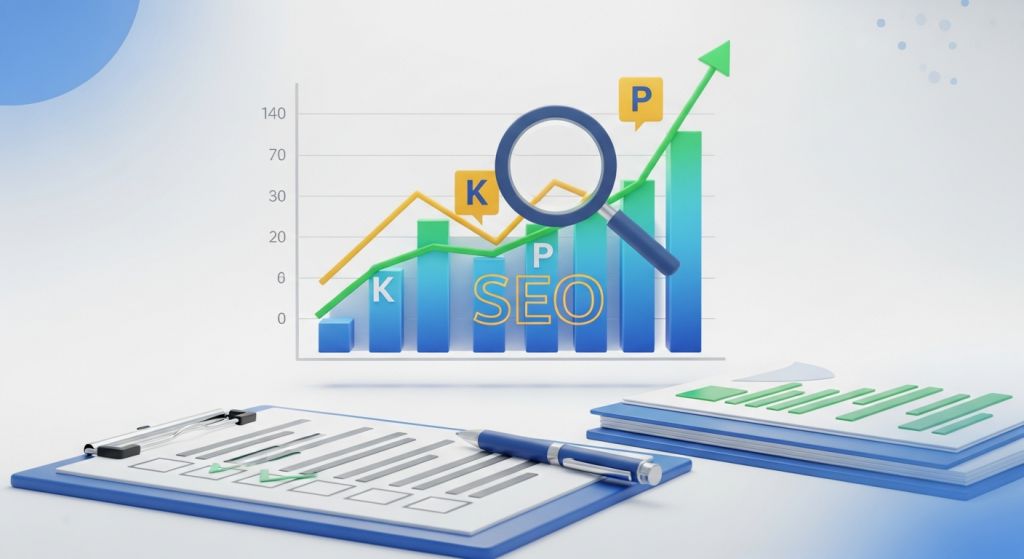 Are Your SEO Efforts Actually Working? Why Reporting and KPIs are a Small Business Game-Changer You’ve invested in search engine optimization because you know it’s essential for long-term growth. You’re creating content, building links, and optimizing your site. But a crucial question often hangs in the air for many small business owners: is it actually working? How do you know if your investment is paying off in more than just vague promises of “more traffic”? The answer lies in effective SEO reporting and a laser-focus on the right Key Performance Indicators (KPIs). Without them, you’re flying blind, pouring time and money into a strategy without a map. This guide will demystify SEO reporting, helping you understand what to measure, why it matters, and how to use that data to drive real, tangible results for your business. What is SEO Reporting (And Why Should You Care)? In simple terms, SEO reporting is the process of collecting and analyzing data about your website’s performance in search engines like Google. A good report doesn’t just throw numbers at you; it tells a story about your online visibility, audience behavior, and how your digital marketing efforts are contributing to your bottom line. For a small business, this isn’t a “nice-to-have” administrative task—it’s a fundamental part of a successful growth strategy. Here’s why it’s so critical: It Provides Accountability: Whether you’re handling SEO in-house or working with an agency, reports provide clear accountability. They show what work has been done and what results it has produced. It Demonstrates ROI: SEO is an investment, not an expense. Clear reporting connects your SEO activities directly to key business goals like leads, sales, and revenue, proving your return on investment (ROI). It Enables Smarter Decisions: Data-driven insights are your best friend. A report can tell you which blog topics are resonating with your audience, which pages are driving conversions, and where technical issues might be holding you back. This allows you to double down on what works and fix what doesn’t. It Uncovers Opportunities: Are you suddenly ranking for a new, high-value keyword? Is a competitor’s website traffic dipping? SEO reports help you spot trends and opportunities you can capitalize on before anyone else. Moving Beyond Vanity Metrics: The KPIs That Truly Matter One of the biggest mistakes in tracking SEO performance is focusing on “vanity metrics.” These are numbers that look impressive on the surface but don’t necessarily translate to business success. A huge spike in website traffic is great, but not if none of those new visitors ever become customers. Instead, a successful SEO Strategy focuses on actionable KPIs that are directly tied to your business objectives. Let’s break down the most important ones into three key categories. 1. Visibility and Traffic KPIs These metrics tell you how visible your brand is in search results and how many people are finding their way to your website. Organic Traffic: This is the number of visitors who arrive at your site by clicking on a link from a search engine results page (SERP), not from a paid ad. It’s the lifeblood of any SEO campaign and a primary indicator of your overall search visibility. A steady increase in organic traffic over time shows your strategy is gaining traction. Keyword Rankings: This is a classic SEO metric that tracks your website’s position in search results for specific keywords. While you shouldn’t obsess over daily fluctuations, monitoring your rank for a core set of high-intent keywords is crucial. Seeing your site move from page three to page one for a term like “local accountant in [Your City]” is a clear sign of progress. Impressions & Click-Through Rate (CTR): Impressions are the number of times your website appeared in someone’s search results. Your Click-Through Rate is the percentage of people who saw your listing and actually clicked on it. A high number of impressions with a low CTR might signal that your page titles and meta descriptions aren’t compelling enough to earn the click, giving you a clear area for improvement. 2. Engagement and User Experience KPIs Once users land on your site, what do they do? These KPIs measure how engaging and user-friendly your website is, which is a major factor in how Google ranks you. Bounce Rate & Dwell Time: Bounce rate is the percentage of visitors who leave your site after viewing only one page. Dwell time is how long they stay on a page before returning to the search results. A high bounce rate and low dwell time can indicate that your content isn’t matching the searcher’s intent or that your site provides a poor user experience. Improving your site’s navigation and content is key here, which often starts with professional Website Design Services that prioritize the user journey. Pages Per Session: This metric shows the average number of pages a visitor views during a single session. A higher number suggests that users are engaged and find your content valuable enough to explore further, which sends positive signals to search engines. Core Web Vitals: This is a set of specific factors that Google considers important in a webpage’s overall user experience. As explained by Google’s own web.dev initiative, they measure loading speed, interactivity, and visual stability. A site that is fast, responsive, and stable not only keeps users happy but is also rewarded with better search rankings. 3. Conversion and Revenue KPIs This is where the rubber meets the road. These KPIs connect your SEO efforts directly to business outcomes and are arguably the most important metrics for any small business owner. Conversion Rate: This is the percentage of your website visitors who complete a desired action, or “conversion.” A conversion can be anything you define as valuable: filling out a contact form, signing up for a newsletter, downloading a guide, or making a purchase. A rising organic conversion rate is the clearest sign that your SEO is attracting the *right* kind of traffic. Goal Completions: In tools like Google Analytics, you can set up specific
 The Google Search You Knew is Gone: How Your Business Can Thrive in the Age of AI Overviews Take a moment and think about how you use Google. For over two decades, the process has been the same: you type a question, you get a list of ten blue links, and you click the one that looks most promising. That era is officially over. In a move that will redefine online visibility, Google has begun rolling out AI-powered summaries, called AI Overviews, directly at the top of its search results for everyone. This isn’t a test. It isn’t a feature you can opt out of. It is the new reality of search. For small business owners, this change can feel intimidating. Will people still click through to my website if Google gives them the answer directly? How can my business possibly show up in these new AI-generated results? These are valid concerns, but this shift is also a massive opportunity for businesses that are ready to adapt. This guide will break down exactly what this change means for you and provide a clear, actionable plan to ensure your business doesn’t just survive, but thrives in this new landscape. What Exactly Are AI Overviews and Why Should You Care? You’ve likely seen them already. You search for something like “how to fix a leaky faucet,” and before you even see a single website link, there’s a shaded box at the top with a complete, paragraph-style answer. That’s an AI Overview. As Google officially announced at its recent I/O conference, this feature is now the default for billions of users. From a List of Links to a Single Conversation Google’s AI is now actively reading, understanding, and synthesizing information from multiple web pages to construct a single, comprehensive answer to a user’s query. It pulls in facts, images, and even product links, presenting them in a conversational format. While it does include links to its sources, they are often presented in small carousels or cards within the AI answer, a stark departure from the familiar ranked list we’ve used for years. The core implication for your business is a potential disruption to your website traffic. For years, the goal of SEO has been to rank in the top few positions to earn a click. Now, the new top position is an AI-generated summary, a reality that marketing experts predict could accelerate the trend of “zero-click searches”, where users get their answer on the results page itself without ever visiting another website. Is This the End of Website Traffic? Not at all, but it is a fundamental change in the *type* of traffic you’ll need to attract. Simple, informational queries (e.g., “what is the capital of Vermont?”) are more likely to be fully answered by AI. However, more complex, nuanced, and purchase-intent queries will still drive users to seek out the expertise and trust of a real business website. The key is to shift your focus from simply being an answer to being the definitive, most trustworthy source that Google’s AI wants to cite and that users *need* to click to learn more. The New Playbook: How to Optimize for Google’s AI Panic is not a strategy. Action is. Getting your business featured in AI Overviews, or at least being a primary source for them, requires a deliberate evolution of your digital marketing strategy. It’s about doubling down on what has always worked in SEO: quality, authority, and user experience. 1. Become the Undisputed Authority (E-E-A-T is Everything) If Google is going to put its own brand on an AI-generated answer, it needs to be absolutely certain the information is accurate and trustworthy. To do this, its algorithms rely heavily on the principles outlined in its quality guidelines, known as E-E-A-T: Experience, Expertise, Authoritativeness, and Trustworthiness. Now more than ever, you must prove to Google that you are a true expert in your field. Show, Don’t Just Tell: Showcase your real-world experience. If you’re a plumber, create detailed case studies of complex jobs. If you’re a financial advisor, write in-depth articles about navigating specific market conditions. Authoritative Content: Publish comprehensive, well-researched content that covers a topic more thoroughly than anyone else. Think ultimate guides, original research, and detailed tutorials. Build Trust Signals: Ensure your website has a detailed “About Us” page, clear author bios for blog posts, easily accessible contact information, and glowing testimonials from real customers. 2. Master Conversational and Long-Tail Keywords People interact with AI conversationally. They don’t just type “plumber chicago”; they ask, “who is the best plumber in Chicago for an emergency water heater repair on a weekend?” Your SEO and content strategy needs to reflect this shift. Focus on answering the highly specific, long-tail questions your potential customers are asking. Use free tools like Google’s “People Also Ask” section or AnswerThePublic to discover these questions. Then, create dedicated blog posts or FAQ sections on your website that answer them directly and comprehensively. When you become the best source for answering these specific, high-intent questions, you become a prime candidate for being featured in an AI Overview. 3. Structure Your Content for AI Readability An AI model is not a human reader. It scans and parses content looking for clear signals and structured data. To make it easy for Google’s AI to understand and cite your content, you need to format it cleanly. Use a Logical Heading Structure: Use H1s for titles, H2s for main sections, and H3s for sub-points. This creates a clear hierarchy. Answer Questions Directly: Start pages that target a specific question with a direct, concise answer before elaborating further. Leverage Lists and Bullet Points: Break down complex information into numbered lists or bullet points (like this one!) to make it easily digestible for both humans and AI. Use Schema Markup: This is a type of code you add to your website to help search engines understand the context of your content. Implementing FAQ schema, review schema, or product schema can give Google the structured
 How to Write SEO-Friendly Service Pages That Convert Your service pages are the most important part of your digital storefront. They are where a curious visitor decides whether to become a paying customer. Yet, too many businesses treat them as an afterthought, resulting in pages that are invisible to search engines and unpersuasive to potential clients. A great service page does two jobs flawlessly: it attracts the right audience through search engine optimization (SEO) and it convinces them to take action. If your service pages aren’t generating leads, you’re leaving money on the table. This guide will walk you through a step-by-step process to create high-performing service pages that climb the search rankings and boost your bottom line. We’ll cover everything from finding the right keywords to crafting compelling copy and designing for conversion. Why Your Service Pages Are a Business-Critical Asset Think of your website as your 24/7 sales team. Your homepage is the friendly greeting, your blog is the helpful expert, but your service pages are the closers. They are the pages that directly connect what you offer with what your customers desperately need. When someone lands on your “Residential Roofing” or “Small Business Accounting” page, they are no longer just browsing; they have a specific problem and are actively looking for a solution. This is where the magic needs to happen. A well-optimized service page accomplishes two primary goals: It Captures Search Traffic: It ranks on Google for keywords that potential customers are using, bringing a steady stream of qualified leads to your digital doorstep. It Drives Conversions: It clearly communicates the value of your service, builds trust, and makes it easy for visitors to take the next step, whether that’s filling out a form, making a call, or scheduling a consultation. Without excelling at both, your pages will fail to deliver a return on investment. A page that ranks well but doesn’t convert is just a vanity metric, and a beautiful page that no one can find is a wasted effort. The Foundation: Strategic Keyword Research for Services Before you write a single word, you need to understand the exact language your customers are using to find services like yours. This is the core of keyword research. It’s not about stuffing your page with buzzwords; it’s about aligning your content with your customer’s intent. Understanding User Intent User intent is the “why” behind a search query. For service pages, you want to target keywords with commercial or transactional intent. These are searches made by people who are ready to hire or buy. For example: Informational Intent: “how to fix a leaky faucet” Commercial Intent: “best plumber in Denver” Transactional Intent: “emergency plumbing services near me” Your service page should target the commercial and transactional keywords. The person searching for “how to fix a leaky faucet” is in a DIY mindset, while the person searching for “emergency plumbing services” needs to hire a professional right now. How to Find the Right Service Keywords Start by brainstorming a list of terms related to your service. Think like a customer. What would you type into Google if you needed what you sell? Write down everything that comes to mind. Then, expand your list by looking at what your direct competitors are ranking for. You can often find their main keywords in their page titles and headings. Focus on “long-tail keywords,” which are longer, more specific phrases. While a keyword like “landscaping” is highly competitive, a long-tail keyword like “drought-tolerant garden design in Austin” is far more specific. It will have lower search volume, but the traffic it attracts is significantly more qualified and more likely to convert. Crafting Compelling Content That Ranks and Converts With your keywords in hand, it’s time to create content that speaks to both search engines and human visitors. Your goal is to be clear, persuasive, and trustworthy. Write a Magnetic Headline (H1 Tag) Your H1 headline is the first thing most people will read. It needs to be crystal clear and include your primary keyword. A winning formula is: Service + Benefit + Location (if applicable). For example: “Professional Teeth Whitening in San Diego for a Brighter, More Confident Smile” This headline immediately tells the visitor what the service is, where it’s offered, and what the ultimate benefit is. It’s a powerful first impression. Hook Them with an Engaging Introduction The first paragraph should grab the reader’s attention by addressing their main pain point. Show them you understand their problem. Then, briefly introduce your service as the ideal solution. Avoid a long-winded company history; get straight to the point and focus on the customer’s needs. Detail Your Service with Clarity and Persuasion This is the core of your page. Break down your service into digestible sections. Use subheadings (H2s and H3s) to structure the content and make it easy to scan. In this section, you should explain: What the service includes: Use bullet points to list the specific deliverables or features. Who the service is for: Clearly identify your ideal customer so they feel seen and understood. The benefits of your service: This is critical. Don’t just list features; explain how those features benefit the customer. Instead of saying “We use SEO software,” say “We use cutting-edge SEO software to uncover hidden opportunities and drive more qualified traffic to your website.” Your process: Briefly walk them through the steps of working with you. This demystifies the process and makes it feel less risky to get started. Build Trust with Social Proof People trust other people more than they trust marketing copy. Weave social proof throughout your service page to build credibility. This can include client testimonials, short case study summaries, logos of well-known companies you’ve worked with, or industry certifications. This not only builds confidence in your visitors but also helps demonstrate your credibility to search engines, aligning with Google’s principles for helpful, people-first content. On-Page SEO Essentials for Service Pages On-page SEO refers to the technical optimizations you make directly on the