Skip to content
 The Ultimate Guide to Image SEO: Boosting Your Visibility and Sales In the digital marketplace, a picture is worth more than a thousand words—it can be worth thousands of visitors. We often focus so much on keywords and written content that we overlook one of the most powerful assets on our websites: our images. But in a world where visual search is on the rise and user experience is paramount, ignoring image search engine optimization (SEO) is like leaving money on the table. For a small business, a well-optimized image can be the difference between being invisible and being discovered. Image SEO is the practice of optimizing your image files so that search engines like Google can easily understand and rank them. This isn’t just about showing up in Google Images; it’s about improving the overall SEO health of your website, enhancing user engagement, and driving qualified traffic to your products and services. A strong image optimization strategy makes your website faster, more accessible, and more appealing to both search engines and human visitors. Why Image SEO Matters More Than You Think Think of your website’s images as silent salespeople. They showcase your products, illustrate your services, and build your brand’s personality. When optimized correctly, they also become powerful magnets for search engine traffic. Google Images is one of the world’s largest search engines, and a high-ranking image can send a steady stream of potential customers directly to your site. Furthermore, image optimization directly impacts critical ranking factors. Large, uncompressed images can drastically slow down your page load speed, a major factor in Google’s ranking algorithm and a huge turn-off for users. A slow site leads to higher bounce rates, telling Google that your page isn’t providing a good user experience. Conversely, a fast-loading site with relevant, well-labeled images keeps visitors engaged, signaling quality and authority to search engines. This is a core component of any effective SEO Strategy. The Core Components of Image SEO Getting started with image SEO doesn’t require a degree in computer science. By focusing on a few key fundamentals, you can make a significant impact on your site’s performance and visibility. Let’s break down the essential elements every business owner should know. Choosing the Right File Name Before you even upload an image to your website, its optimization journey begins with the file name. Search engines read file names to understand the image’s context. A generic name like `IMG_7890.jpg` provides zero information. Instead, use a descriptive, keyword-rich file name that clearly explains what the image is about. For example, if you’re a bakery in Denver selling custom cakes, a photo of a chocolate birthday cake should be named something like `denver-chocolate-birthday-cake.jpg` instead of `photo1.jpg`. This simple step gives Google an immediate clue about the image’s content, helping it rank for relevant search terms. Writing Compelling Alt Text Alt text (alternative text) is arguably the most important element of image SEO. It’s a short description of an image that serves two primary purposes: Accessibility: Screen readers use alt text to describe images to visually impaired users, ensuring everyone can access your content. SEO: Search engine crawlers cannot “see” images like humans do. Alt text provides the context they need to understand the image’s subject matter and index it properly. Good alt text is descriptive and concise. It should paint a clear picture of the image while naturally including relevant keywords. Avoid “keyword stuffing,” which is cramming as many keywords as possible into the description. For our bakery example, a good alt text would be: `alt=”A rich, three-layer chocolate birthday cake with fudge frosting and rainbow sprinkles on a white cake stand.”` This is far more useful to both users and search engines than `alt=”cake birthday cake denver baker cake shop.”` Image File Size and Compression Page speed is everything. According to data compiled by Google, the probability of a visitor bouncing from your site increases by 32% as page load time goes from 1 to 3 seconds. Large images are the most common cause of slow-loading websites. The goal is to find the perfect balance between image quality and file size. Before uploading any image, you should compress it to reduce its file size without a noticeable loss in visual quality. There are many free and easy-to-use online tools like TinyPNG or Squoosh that can shrink your image files significantly. A well-designed website integrates these performance practices from the ground up, which is a key focus of our Website Design Services. Aim to keep most of your web images under 150 KB for optimal performance. Selecting the Best Image Format The file format you choose also impacts image quality and size. You don’t need to be a graphic designer to make the right choice. Here are the most common formats and when to use them: JPEG (or JPG): The best choice for photographs and complex images with many colors. JPEGs offer a great balance of quality and file size. PNG: Use this format when you need a transparent background, such as for logos or icons. PNG files are generally larger than JPEGs but offer lossless quality. WebP: A modern image format developed by Google that provides superior compression and quality compared to both JPEG and PNG. It’s widely supported by modern browsers and is an excellent choice for improving load times. SVG: A vector format used for logos, icons, and simple illustrations. SVGs are resolution-independent, meaning they look sharp at any size, and typically have very small file sizes. Advanced Image SEO Strategies Once you’ve mastered the basics, you can implement more advanced techniques to give your website a competitive edge. These strategies help search engines discover and feature your images more prominently. Leveraging Structured Data Structured data (or schema markup) is code you can add to your website to help search engines better understand your content. For images, you can use specific types of schema to provide more context, such as marking up a product image with its price and availability or a recipe
 The New Rules of SEO: How to Win in Google’s AI-Powered Search The way your customers find you online just went through a seismic shift. For years, the goal has been simple: get to the top of Google’s search results. But what if the top spot isn’t a link to a website anymore? What if it’s a block of text generated by artificial intelligence? That’s not a hypothetical question; it’s the new reality of search thanks to the full rollout of Google’s AI Overviews. This is arguably the biggest change to search engine results in over a decade, and it has profound implications for your small business. For companies that rely on a steady stream of website traffic from Google, this moment can feel unsettling. But with change comes opportunity. Understanding this new landscape is the first step not just to surviving, but to thriving. This guide will break down exactly what AI Overviews are, why they matter to you, and the practical steps you can take right now to adapt your digital marketing strategy and protect your online visibility. What Exactly Are Google’s AI Overviews? You’ve likely already seen them in action. When you type a question into Google, you might see a shaded box at the very top of the results page that provides a direct, conversational answer. That’s an AI Overview. Instead of just giving you a list of links, Google’s AI now synthesizes information from multiple top-ranking web pages to create a single, comprehensive summary. Think of it as a research assistant. If you ask, “what are the best drought-resistant plants for a sunny yard in Texas?” the AI Overview won’t just point you to a few gardening blogs. It will pull key information—plant names, watering needs, sun requirements—from those blogs and present it in a neat, easy-to-read summary. While links to the source websites are often included, the immediate answer is right there on the search page. The goal for Google is to provide a faster, more intuitive experience for users with complex questions. The challenge for businesses is that this convenience can come at the cost of a click to your website. Why This Is a Game-Changer for Your Small Business For years, a solid SEO strategy has been a reliable engine for growth, driving potential customers to your digital doorstep. The introduction of widespread AI-powered search fundamentally alters that dynamic. Here’s why this requires your immediate attention. The Growing Threat of the “Zero-Click Search” The most immediate impact is the potential for a sharp decline in website traffic. When a user’s question is answered completely within the AI Overview, they have no reason to click through to any of the source websites. This phenomenon, known as a “zero-click search,” has existed for a while with features like Featured Snippets and People Also Ask boxes, but AI Overviews take it to a whole new level. If your content strategy is built around answering simple, informational questions, you are particularly vulnerable. A significant portion of the traffic you once received for these queries could evaporate as Google’s AI simply serves up your hard-earned information directly on the results page. This directly impacts lead generation, ad revenue, and product sales that originate from your informational blog content. A Necessary Shift in Keyword Strategy The days of targeting broad, high-volume keywords as your primary strategy are numbered. Simple queries like “how to change a tire” or “what is a 401k” are prime candidates for being answered entirely by an AI Overview. The value of ranking for these terms will diminish if they no longer result in clicks. Your new focus must be on nuance and intent. Your SEO strategy needs to pivot towards more complex, multi-step questions and long-tail keywords that an AI will struggle to answer in a single summary. It’s about understanding the deeper problems your customers face and creating content that addresses their unique, specific situations—the kind of queries that still warrant a click to a dedicated, expert resource. Your New Top Competitor Is the AI Itself Previously, your goal was to outrank other businesses. Now, you also have to compete with the AI Overview that sits above everyone else. Being featured as a source within the AI-generated answer is the new “position zero.” If your site isn’t cited, your expertise is invisible for that search, even if your website technically ranks on the first page below the overview. This means your content must be so valuable, trustworthy, and well-structured that Google’s AI chooses it as a foundational source for its answers. How to Adapt Your SEO Strategy for the AI Era This isn’t a time for panic, but a time for smart, strategic action. The fundamentals of good SEO are more important than ever, but they need to be applied through the new lens of AI-powered search. Here’s how you can adjust your approach. Double Down on E-E-A-T E-E-A-T stands for Experience, Expertise, Authoritativeness, and Trustworthiness. This is Google’s framework for measuring content quality, and in the age of AI, it’s your most powerful asset. For its AI to trust your content, Google needs to see clear signals that you are a legitimate expert in your field. To do this, you should: Showcase firsthand experience with detailed case studies, original research, and real-world examples. Create comprehensive author bios that highlight credentials and expertise. Earn backlinks from other reputable websites in your industry. Display customer reviews, testimonials, and trust signals prominently on your site. By focusing on what Google calls creating helpful, reliable, people-first content, you align your website with the core principles Google uses to evaluate information, making it more likely your content will be used as a trusted source for AI Overviews. Focus on Niche Expertise and Specific Answers Broad, general content is now the AI’s playground. Your opportunity lies in the specific. Become the undeniable expert in your niche. Instead of writing about “digital marketing,” write about “local SEO for multi-location dental practices.” Instead of “home renovation tips,” focus on
 Is Your Business Ready for the Voice Search Revolution? A Guide for Small Business Owners “Hey Siri, where can I find the best coffee near me?” “Alexa, what are the hours for the local hardware store?” “Okay Google, find a plumber who can come today.” If you’ve used a smartphone or smart speaker in the last few years, these phrases probably sound familiar. What was once a novelty has become a daily habit for millions of people. This fundamental shift from typing on a keyboard to speaking a command is not just changing how we get information; it’s revolutionizing how customers find and interact with businesses like yours. Welcome to the era of voice search. For small business owners, this isn’t a trend to ignore. It’s an opportunity to get ahead of the competition and connect with customers in a more natural, direct way. This guide will demystify voice search optimization, explain why it’s critical for your growth, and provide actionable steps you can take to ensure your business is heard. What is Voice Search and Why Does It Matter? At its core, voice search is exactly what it sounds like: using your voice to ask a question or give a command to a device, which then searches the internet for an answer. This is powered by virtual assistants like Apple’s Siri, Amazon’s Alexa, and Google Assistant. The key difference lies not just in the input method, but in the user’s intent and expectations. The Exponential Shift from Typing to Talking The convenience of voice search is undeniable. It’s faster than typing, hands-free, and feels more like a natural conversation. This ease of use has led to explosive growth. Projections show that the number of voice assistant users worldwide is growing rapidly, with billions of devices already equipped with the technology. According to an industry report highlighted by Forbes, over half of all smartphone users now engage with voice technology. What does this mean for your business? It means a significant portion of your potential customers are no longer typing “pizza delivery” into a search bar. They’re asking, “Hey Google, order a large pepperoni pizza from a place that delivers.” If your online presence isn’t optimized to answer that specific, conversational query, you’re becoming invisible to a growing audience. How Voice Search Differs from Traditional Search Understanding the fundamental differences between typed and spoken searches is the first step toward effective optimization. The shift is from fragmented keywords to complete, natural-sounding questions. Conversational Language: Typed searches are often short and to the point (e.g., “plumber emergency Boston”). Voice searches, however, mirror human speech (e.g., “Who is the best emergency plumber near me in Boston?”). Question-Based Queries: A large percentage of voice searches are phrased as questions, often starting with who, what, where, when, why, or how. Your content needs to be structured to directly answer these questions. High Local Intent: Many voice searches are for on-the-go needs. Users are often looking for directions, business hours, or local services. In fact, consumers use voice search significantly more for local business information than for anything else. This makes local SEO more critical than ever. The Expectation of a Single, Direct Answer: When you type a query, you get a page with ten blue links. When you ask a voice assistant, it typically provides one single answer, often read aloud from a “featured snippet” at the very top of the search results. If you aren’t that single answer, you don’t exist in that search. The Core Pillars of Voice Search Optimization Getting your business ready for voice search isn’t about throwing out your existing marketing efforts. It’s about enhancing them with a new perspective. By focusing on a few key areas, you can significantly improve your chances of being the answer your customers are looking for. 1. Focus on Conversational, Long-Tail Keywords The era of stuffing your website with one or two-word keywords is over. Voice search is dominated by long-tail keywords—longer, more specific phrases that mimic natural speech. Think about the exact questions your customers would ask about your products or services. Instead of optimizing for “HVAC repair,” you should target phrases like “How much does it cost to fix an air conditioner?” or “What are the signs I need a new furnace?” The best way to do this is by creating content that directly answers these questions, such as a detailed FAQ page or a series of informative blog posts. This not only aligns with voice search queries but also establishes your business as a trusted authority. A comprehensive SEO Strategy should make answering customer questions a central pillar of your content plan. 2. Aim for “Position Zero” with Featured Snippets As mentioned, voice assistants love to pull their answers from Google’s featured snippets. This is the box that appears at the top of the search results page, providing a direct, concise answer to a user’s query. Earning this spot, often called “Position Zero,” is a primary goal of voice search optimization. How do you get there? Google tends to pull snippets from content that is well-structured and directly answers a question. Here are a few tips: Structure your content with clear, question-based headings (like the ones in this article). Provide a concise, direct answer to the question immediately below the heading. Use numbered or bulleted lists to break down information, as these are easy for Google to parse and feature. Ensure your content is accurate, well-written, and provides genuine value to the reader. 3. Dominate Local Search with Your Google Business Profile For any business with a physical location or service area, optimizing for local search is non-negotiable. Voice searches for “near me” have skyrocketed, and Google Assistant will almost always pull results from Google Maps and Google Business Profile (GBP) listings. Your GBP listing is a powerful, free tool that acts as a digital storefront. To optimize it for voice search, you must be meticulous. According to SEO experts at Moz, a complete and accurate GBP is one
 The Future of Search Is Here: How to Prepare Your Business for Google’s AI Overviews If you’ve used Google in the last few days, you might have noticed something radically different. The familiar list of ten blue links is no longer always at the top. Instead, you’re often greeted with a detailed, conversational summary that directly answers your question. This, my friends, is the official rollout of Google’s AI Overviews, and it’s not just another minor update—it’s the single biggest shift in search behavior we’ve seen in over a decade. Announced with great fanfare at their recent I/O conference, Google is now integrating generative AI answers directly into its main search results for billions of users. For small business owners, this change brings both a significant challenge and a massive opportunity. The way customers discover your products, services, and expertise online is fundamentally changing. Ignoring this shift isn’t an option. But by understanding how it works and adapting your strategy now, you can position your business to thrive in this new era of search. This article will break down exactly what AI Overviews are, how they will impact your website’s traffic, and most importantly, provide a clear, actionable plan to adapt your digital marketing strategy today. What Exactly Are Google’s AI Overviews? Think of AI Overviews as Google’s attempt to be a super-intelligent research assistant. Instead of just giving you a list of potential sources (the classic links), it now reads, synthesizes, and understands the information from those sources to provide a single, comprehensive answer at the very top of the page. It’s designed to help users get quick, multi-faceted answers to more complex questions without having to click through to multiple websites. These summaries are powered by Google’s advanced Gemini AI model. When you ask a question like, “what are the best durable materials for a patio in a rainy climate,” the AI doesn’t just look for those keywords. It understands the intent behind the question and scours top-ranking pages for information on various materials, their pros and cons, costs, and maintenance needs. It then pieces all of this together into a coherent, easy-to-digest summary, complete with links to the websites it used as sources. The key takeaway here is the inclusion of those source links. While the AI provides the summary, it still credits the original creators of the information. This is where the new opportunity for your business lies. The Big Question: How Will This Impact Your Business? Let’s be direct: the initial reaction for many website owners is fear. If Google answers the question directly, why would anyone need to click on your website? It’s a valid concern, and it highlights the core challenge of this new reality. The Challenge: The Rise of “Zero-Click” Searches For simple, informational queries, we will likely see a significant drop in click-through rates. If a user can get a quick definition, a simple recipe, or a quick fact from the AI Overview, their journey ends there. This phenomenon, often called “zero-click search,” has been growing for years with features like Featured Snippets, but AI Overviews will accelerate it dramatically. Businesses that have built their content strategy around high-volume, top-of-funnel informational keywords may see their organic traffic dip. Relying on ad revenue from high-traffic blog posts could become a much tougher game. According to early analysis from industry experts, the impact on traffic could be substantial, forcing a major rethink of how we measure SEO success. It’s a reality we must prepare for. The Opportunity: Becoming the Cited Authority Here’s the silver lining, and it’s a big one. AI Overviews don’t create information out of thin air; they synthesize it from existing, high-quality content on the web. Within every AI-generated answer are links to the pages it considers credible sources. Getting your website featured as a source in an AI Overview is the new “position zero.” Think about the value of that placement. It’s a powerful endorsement directly from Google. A user who reads an AI summary and wants to dive deeper is now presented with a short list of highly-vetted sources. A click from one of these links is not just a random visitor; it’s a highly qualified lead who sees your business as an authoritative and trustworthy resource on the topic. The goal of SEO is no longer just to rank first, but to be the definitive answer that the AI itself trusts and recommends. How to Adapt Your SEO Strategy for an AI-Powered World So, how do you become one of those trusted sources? It’s not about “tricking” an algorithm. It’s about doubling down on the fundamentals of great content and technical excellence. Your new focus should be on creating the most helpful, clear, and expert-driven content in your niche. 1. Create Genuinely Helpful, People-First Content The era of thin, keyword-stuffed articles written just for search engines is officially over. Google’s AI is designed to recognize and reward content that demonstrates true E-E-A-T: Experience, Expertise, Authoritativeness, and Trustworthiness. Your content must prove you know your stuff. Show, Don’t Just Tell: Use case studies, original data, customer testimonials, and real-world examples to back up your claims. Write from Experience: If you’re a plumber writing about leaky pipes, share first-hand insights and unique tips that can only come from years on the job. Keep it Clear and Concise: Use simple language, short paragraphs, and clear headings. Make it easy for both humans and AI to understand your main points. As Google’s own guidelines on helpful content state, you should focus on creating content for people, not primarily for search engines. 2. Answer Questions Directly and Comprehensively Your content strategy needs to be laser-focused on answering your customers’ most pressing questions. Go beyond the obvious and think about the follow-up questions they might have. Structure your content to provide clear, direct answers that an AI can easily extract. Consider dedicating entire articles or sections of your website to answering specific long-tail questions. An effective SEO & Content Strategy now involves
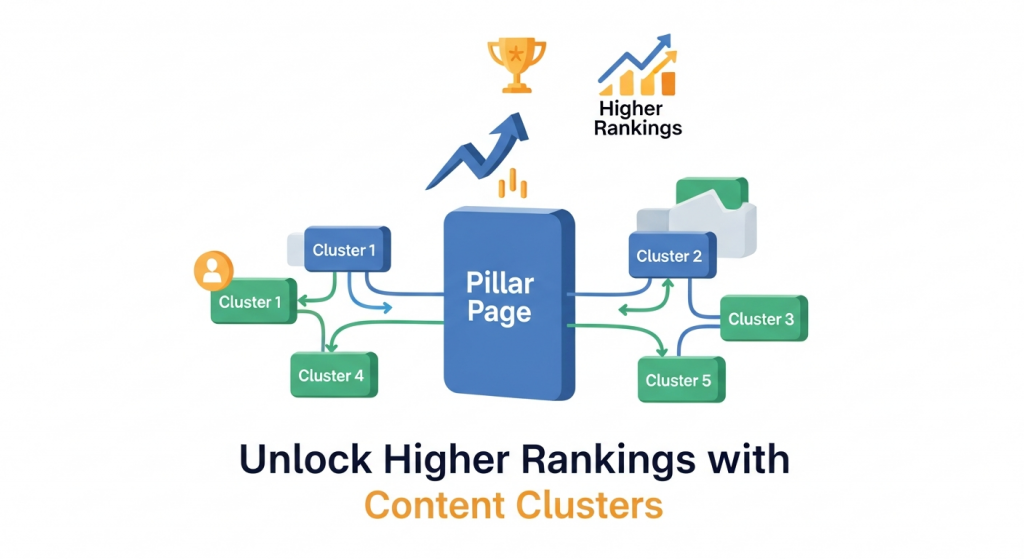 Unlock Higher Rankings: A Small Business Guide to SEO Content Clusters The End of the Content Treadmill As a small business owner, you’ve likely heard the mantra: “content is king.” You’ve spent hours brainstorming, writing, and publishing blog posts, hoping each one will be the magic bullet that lands you on the first page of Google. But often, the results are underwhelming. Your articles get a brief spike in traffic and then fade into the digital background, and your search rankings barely move. This is the content treadmill, and it’s exhausting. The problem isn’t your effort; it’s the strategy. In the past, SEO was a game of targeting individual keywords. You’d write one article for “best coffee grinders” and another for “how to clean a coffee grinder.” Today, search engines like Google are far more sophisticated. They don’t just look for keywords; they look for expertise. They want to reward websites that demonstrate deep, comprehensive knowledge on a particular subject. This is called topical authority, and the single best way to build it is with content clusters. What Are Content Clusters, Really? Imagine you want to write a definitive book about digital marketing for your customers. You wouldn’t just write 50 disconnected chapters and toss them in a pile. You’d create a structured book with a table of contents (the main overview) and individual chapters that dive deep into specific subjects like email marketing, social media, and SEO. A content cluster works exactly the same way for your website. This powerful SEO model organizes your content around central topics, proving your expertise to both search engines and human readers. There are three core components. The Pillar Page The pillar page is your “table of contents.” It’s a long, comprehensive piece of content that covers a broad topic from top to bottom. For a landscaping company, a pillar page might be “The Ultimate Guide to Garden Design.” This page touches on all aspects of the topic—planning, soil types, plant selection, hardscaping, etc.—but doesn’t go into exhaustive detail on any single one. Its goal is to be the central hub for that topic on your website. The Cluster Content The cluster content pieces are your “chapters.” These are individual blog posts or articles that explore a specific subtopic from your pillar page in great detail. Using the landscaping example, cluster content could include articles like “How to Choose the Right Plants for a Shady Garden,” “5 Low-Maintenance Hardscaping Ideas,” or “A Beginner’s Guide to Soil Testing.” Each of these articles is a deep dive that answers a very specific question related to the main pillar topic. The Internal Links Internal links are the glue that holds the entire structure together. This is the most crucial part for SEO. Each piece of cluster content must link back to the main pillar page. In turn, the pillar page should link out to all of its supporting cluster articles. This creates a web of interconnected content that signals a clear relationship to search engines. It tells Google, “Hey, not only did we write about this one specific thing, but we have a whole library of expert content on the broader subject.” Why Your Small Business Needs a Content Cluster Strategy Adopting a topic cluster model isn’t just about organizing your blog; it’s a fundamental shift that produces tangible business results. It moves you from shouting random keywords into the void to strategically building a fortress of expertise that search engines and customers will reward. Build Unshakeable Topical Authority When you create an interconnected hub of content around a specific subject, you’re not just a site with a blog post; you’re an authority. Search engines are designed to find and promote experts. By thoroughly covering a topic, you signal to Google that you are a credible source of information, making it more likely to rank your pages higher. As experts at Moz explain, this authority is a powerful competitive advantage that is difficult for others to replicate. Improve Search Engine Rankings for High-Value Keywords The strategic internal linking within a cluster does more than just organize content; it funnels authority. When one of your cluster articles earns a backlink or gets a lot of traffic, the “ranking power” from that page is shared with the pillar page and other connected articles through the internal links. This rising tide lifts all boats, helping the entire cluster of pages rank higher for a wide range of related keywords, from broad terms to specific long-tail questions. Enhance User Experience and Engagement A user who lands on one of your detailed cluster articles can easily navigate to the main pillar page to get a broader overview or click through to other related articles to learn more. This keeps them on your website longer, reducing your bounce rate and increasing pages per session. These are strong positive signals to search engines that users find your site valuable. A seamless user journey is a core component of great Website Design Services and is essential for turning visitors into leads. Streamline Your Content Creation Ever sit down to write and draw a complete blank? The content cluster model provides a built-in content calendar. Once you’ve chosen your pillar topic, you can easily generate a dozen or more ideas for cluster articles. This focused approach ensures every piece of content you create has a clear purpose and contributes to a larger strategic goal, ending the cycle of random content creation for good. How to Build Your First Content Cluster: A 5-Step Guide Getting started with content clusters is more straightforward than you might think. It requires a bit of planning upfront, but the long-term payoff is immense. Here’s a simple five-step process for small businesses. Step 1: Choose Your Core Topic (The Pillar) Start by brainstorming the broad subjects that are central to your business and, more importantly, to your customers’ problems. What do they need to know before they buy from you? A good pillar topic is broad enough to generate numerous
 Is Your Website Traffic Nosediving? What to Do About Google’s March 2024 Core Update If you’ve noticed some wild swings in your website traffic recently, you’re not alone. In March 2024, Google rolled out one of its most significant and complex algorithm updates in years, and the aftershocks are still being felt across the web. For small business owners, this isn’t just tech news; it’s a direct threat to your online visibility, lead generation, and ultimately, your bottom line. But don’t panic. This change also presents a massive opportunity for businesses that are doing things the right way. This update is all about cleaning up the search results and rewarding what Google calls “helpful, reliable, people-first content.” It’s a clear signal that the old tricks of keyword stuffing and churning out low-effort articles just to rank are officially dead. In this article, we’ll break down exactly what the March 2024 Core Update is, why it matters so much, and give you a practical, step-by-step guide to ensure your website not only survives but thrives in this new landscape. What Exactly Is the March 2024 Google Update? Think of this less as a single tweak and more as a fundamental shift in how Google evaluates websites. For years, Google has been on a mission to deliver search results that are genuinely useful to users. This latest update is a major leap forward in that mission. It combines several overlapping changes aimed at one primary goal: reducing the amount of unoriginal and unsatisfying content in its search results by a whopping 40%. Unlike previous updates that might target one specific issue, this one is multifaceted. According to Google’s official announcement, the changes are designed to better identify and penalize content that seems created solely to attract clicks from search engines, rather than to inform or help a real person. The Main Targets of the Update Google has been very clear about the types of low-quality content it’s cracking down on. Understanding these will help you see what to avoid: Scaled Content Abuse: This is a big one. It refers to generating massive amounts of unoriginal content, often using AI or other automated means, with the primary goal of manipulating search rankings. If a website has hundreds of generic, soulless blog posts that all say the same thing, it’s now at risk. Site Reputation Abuse: Have you ever seen a trustworthy news or educational website with a weird, spammy section full of product reviews or payday loan articles? That’s site reputation abuse. It’s when third parties publish low-quality content on an otherwise reputable site to take advantage of its authority. Google is now devaluing this “rented out” space. Expired Domain Abuse: This is a tactic where someone buys an old, expired domain name that once had authority (like a former doctor’s office) and repurposes it to rank for something completely unrelated (like online gambling). Google is getting much smarter at spotting and ignoring this manipulative practice. The core message is simple: shortcuts are out. Authenticity and genuine value are in. For small businesses that have always focused on serving their customers well, this is very good news. Why This Matters More Than Ever for Your Business So, what does all this technical talk mean for you, the business owner? It means the connection between a quality website and a healthy business has never been stronger. If a significant portion of your leads and sales comes from people finding you on Google, this update is a critical business issue. Imagine your physical storefront is on a busy main street, getting lots of foot traffic every day. An algorithm update is like the city suddenly rerouting traffic, and if your store isn’t up to the new code, you could find yourself on a deserted side street overnight. A sudden drop in rankings means a sudden drop in visibility, traffic, phone calls, and sales. It can be devastating. However, the reverse is also true. As Google demotes unhelpful, spammy websites, it creates a vacuum at the top of the search results. This is your chance to rise up and capture that valuable traffic. By aligning your digital strategy with what Google is rewarding—high-quality, user-focused content—you can build a more resilient and profitable online presence that isn’t vulnerable to these kinds of shake-ups. Your 5-Step Action Plan to Thrive Post-Update Feeling a little overwhelmed? That’s completely normal. The good news is that the path forward isn’t about learning complex code or trying to “trick” Google. It’s about getting back to marketing fundamentals. Here are five actionable steps you can take right now. 1. Conduct a Ruthless Content Audit It’s time for some spring cleaning. Go through your website’s pages and blog posts and ask yourself some tough questions about each piece: Does this content truly help my ideal customer? Does it answer their questions thoroughly? Does it showcase our unique expertise? Is it well-written and easy to read? If the answer is no, you have two choices: improve it drastically or remove it. Deleting thin, unhelpful content can often be more beneficial for your SEO than keeping it. A comprehensive content audit is the foundation of a modern search strategy. Our SEO & Content Strategy services are designed to identify these weaknesses and build a roadmap for creating content that drives real business results. 2. Double Down on E-E-A-T E-E-A-T stands for Experience, Expertise, Authoritativeness, and Trustworthiness. It’s the framework Google uses to assess content quality and whether a source is credible. As explained by marketing expert Neil Patel, demonstrating these signals is crucial. Here’s how: Experience: Show, don’t just tell. Share case studies, personal stories, and real-world examples. If you’re a plumber, write about a tricky installation you solved, don’t just write a generic “how to choose a plumber” article. Expertise: Create detailed, comprehensive content that proves you know your stuff. Feature author bios for your blog posts that highlight the writer’s credentials. Authoritativeness: Earn backlinks from other reputable sites in your industry, gather positive
 How AI Is Reshaping the Future of SEO (And What It Means for Your Business) If you feel like you’re hearing about Artificial Intelligence everywhere, you’re not wrong. From smartphones to customer service, AI is quietly reshaping our world. But nowhere is this transformation more profound than in the realm of search engine optimization (SEO). For small business owners, understanding this shift isn’t just about keeping up with trends—it’s about ensuring your business remains visible to customers in a rapidly evolving digital landscape. AI is no longer a futuristic concept in SEO; it’s the engine driving it. Search engines like Google are using sophisticated AI to better understand what users are looking for and to deliver more relevant, helpful answers. This means the old rules of keyword stuffing and chasing backlinks are becoming less effective. The future of SEO is smarter, more conversational, and more focused on the human user than ever before. In this article, we’ll demystify how AI is changing SEO and provide a clear, actionable roadmap for your business to thrive. The New Search Engine: How AI Powers Google To understand the future of SEO, you first need to understand how AI has become the backbone of modern search engines. Google has been using AI for years with systems like RankBrain and BERT, which helped the search engine decipher the context and nuance of search queries. But recent developments have taken this to a whole new level, fundamentally changing what a search results page looks like. From Keywords to Conversations: The Rise of Generative AI The most significant recent change is Google’s Search Generative Experience (SGE). Instead of just showing a list of blue links, SGE uses generative AI to provide a detailed, conversational answer directly at the top of the search results page. It synthesizes information from multiple web pages to create a comprehensive “AI snapshot” that answers the user’s query on the spot. What does this mean for you? It means the user’s journey is changing. They may get their answer without ever clicking on a website. This makes it crucial for your content to be so valuable and authoritative that it gets featured in these AI snapshots and entices users to click through for more information. According to Google’s own announcements, this feature is designed to help people “understand a topic faster, uncover new viewpoints and insights, and get things done more easily.” Your goal is to be one of those key viewpoints. Understanding User Intent Like Never Before At its core, AI gives search engines an almost human-like ability to understand “user intent”—the real goal behind a search query. When a user searches for “best running shoes,” they aren’t just looking for a product page. They might be looking for reviews, comparisons of different brands, information on shoes for specific foot types, or advice on where to buy them locally. AI helps Google understand this underlying intent and deliver a mix of results that serve it, including blog posts, videos, product listings, and local maps. For your business, this means you must move beyond targeting simple keywords and start creating content that comprehensively answers the questions your potential customers are asking. A robust SEO strategy is no longer about matching words; it’s about matching intent. How to Adapt Your SEO Strategy for an AI-Powered World Knowing that AI is changing the game is one thing; knowing how to adapt is another. The good news is that the principles of good marketing still apply. The focus is shifting away from technical tricks and toward providing genuine value to your audience. Here are the key areas to focus on. Double Down on High-Quality, Human-First Content If there is one takeaway from the rise of AI in search, it’s this: quality has never mattered more. With AI able to generate mediocre content in seconds, your unique human perspective is your greatest asset. Google is prioritizing content that demonstrates what it calls E-E-A-T: Experience, Expertise, Authoritativeness, and Trustworthiness. As explained by experts at Search Engine Journal, E-E-A-T is Google’s framework for identifying high-quality content. To align with it, your content should: Showcase First-Hand Experience: Write about what you know. If you’re a plumber, create content that details how you solved a unique problem. If you own a bakery, share the story behind your most popular recipe. Demonstrate Genuine Expertise: Go beyond surface-level information. Create in-depth guides, case studies, and tutorials that prove you are an expert in your field. Build Authority and Trust: Earn backlinks from reputable sites, gather positive customer reviews, and ensure your website provides clear contact information and author bios. In an AI-driven world, your authentic voice and real-world experience are your most powerful SEO tools. Rethink Your Keyword Research The way people search is becoming more conversational, partly due to the rise of voice assistants like Siri and Alexa. Instead of typing “pizza Chicago,” people are now asking, “What’s the best deep-dish pizza place near me that’s open late?” Your keyword research needs to reflect this shift. Focus on long-tail keywords and question-based queries that mirror natural language. Think about the entire customer journey and create content for each stage. Build “topic clusters”—a main pillar page covering a broad topic, linked to several sub-pages that cover specific aspects of that topic in detail. This structure signals to AI-powered search engines that you are a comprehensive authority on the subject. Prioritize Technical SEO and User Experience (UX) All the great content in the world won’t matter if your website is slow, confusing, or broken on mobile devices. AI can’t fix a poor user experience. A strong technical foundation is a prerequisite for success in modern SEO. This includes: Mobile-First Design: Your site must look and work perfectly on all screen sizes. Fast Page Speed: Users expect pages to load in two seconds or less. Slow sites lead to high bounce rates, which tells Google your page isn’t helpful. Intuitive Navigation: Users and search engine crawlers should be able to easily find what they’re
 Google’s AI Overviews Are Here. Is Your Small Business Ready for the New SEO? Take a deep breath. The world of online search just experienced its biggest earthquake in over a decade. If you’ve used Google in the last few days, you might have noticed something new at the very top of the results: a clean, conversational, AI-generated summary answering your question directly. This isn’t a test or a beta feature anymore. This is Google’s new reality, and it’s called AI Overviews. On May 14th, Google announced the full rollout of AI Overviews to all users in the United States, with a global expansion planned for the near future. For small business owners, this isn’t just a minor tweak to the algorithm; it’s a fundamental shift in how your potential customers will find you. The old playbook of ranking number one might not be enough anymore. But don’t panic. Change always creates opportunity, and the businesses that understand this new landscape and adapt quickly will not only survive—they will thrive. This article will break down exactly what AI Overviews are, what they mean for your website traffic, and the concrete steps you need to take to adjust your digital marketing strategy today. What Are Google AI Overviews (And Why Should You Care)? Imagine you ask Google, “what are the best durable and pet-friendly flooring options?” Instead of just getting a list of ten blue links to click, Google now presents a detailed, synthesized paragraph right at the top. This “AI Overview” pulls information from multiple websites, blogs, and reviews to give you a direct, comprehensive answer. It might compare vinyl, laminate, and tile, list pros and cons for each, and even link to a few of its sources. For the user, it’s a faster, more conversational way to get information. For your business, it means the game has changed. You’re no longer just competing for a top-ten spot on a list; you’re competing to be a trusted source for the AI itself. The Real Impact on Your Business Why is this such a big deal? Because it fundamentally alters the user journey. The traditional path was: Search > Scan Links > Click > Visit Website. Now, for many queries, the path will be: Search > Get Answer. This introduces a very real possibility of “zero-click searches,” where a user gets what they need without ever visiting a single website. This is the moment every business owner needs to pause and consider the implications. If your primary strategy for attracting customers is ranking for simple informational questions, you could see a significant drop in traffic. However, if a user’s journey is more complex—if they’re looking for a local service, comparing specific products, or need deep expertise—the AI Overviews could become your new best friend by citing your website as a key resource, driving highly qualified traffic your way. The “Zero-Click” Threat: Will Your Website Traffic Disappear? The immediate fear for many is that website traffic will plummet. While it’s a valid concern, the reality is likely to be more nuanced. According to initial data shared by Google, the links included in AI Overviews are actually getting more clicks than traditional web listings. The key is to be one of those included links. Think of it this way: Simple, Factual Queries: Questions like “how tall is the Eiffel Tower?” will almost certainly become zero-click searches. The user gets the fact and moves on. Complex, Research-Based Queries: Questions like “develop a 3-day marketing plan for a new local coffee shop” will generate detailed AI Overviews that cite multiple expert sources. Being one of those sources is the new “position zero.” Local and Commercial Queries: Searches with high purchase intent, like “emergency plumber near me” or “best CRM for small businesses,” will still heavily feature local businesses and product reviews. The AI Overview might summarize options, but users will still need to click to book a service or make a purchase. The goal is no longer just to rank, but to be *the answer*. Your content needs to be so valuable, authoritative, and well-structured that Google’s AI chooses it as a foundational source for its summary. This is where your focus on a modern SEO and content strategy becomes absolutely critical. How to Adapt Your SEO Strategy for an AI-Powered World So, how do you make your website an indispensable resource for Google’s AI? It’s not about secret hacks or trying to trick the system. It’s about doubling down on the fundamentals of great marketing and creating genuinely helpful content. Here’s your new action plan. 1. Double Down on E-E-A-T E-E-A-T stands for Experience, Expertise, Authoritativeness, and Trustworthiness. This has been a core part of Google’s quality guidelines for years, but with AI in the driver’s seat, it is now non-negotiable. AI models are specifically designed to identify and prioritize content from sources that demonstrate these qualities. You need to prove you’re a real expert. Show, Don’t Just Tell: Add detailed author bios with credentials. Showcase case studies with real data. Display customer testimonials and reviews prominently. Be Transparent: Clearly state who you are and what your business does. Have an easy-to-find contact page and a comprehensive “About Us” section. Cite Your Sources: When you make claims, link out to reputable sources to back them up, just as a good journalist would. 2. Create Content That Answers Questions Brilliantly Your content must now be the best, most comprehensive answer to a user’s problem. A short, 500-word blog post that barely scratches the surface is no longer enough. Your content needs depth. Instead of just targeting a keyword like “small business accounting,” create a comprehensive guide titled “The Ultimate Guide to Accounting for Small Businesses in 2024.” Cover everything: software options, tax tips, common mistakes, when to hire a professional. Structure your articles with clear headings (H2s, H3s), bullet points, and numbered lists so the AI can easily parse and understand the information. Think of your website as an encyclopedia for your niche. 3.
 How to Perform a DIY SEO Audit: A Small Business Owner’s Guide As a small business owner, you wear many hats. You’re the CEO, the head of sales, the customer service manager, and often, the chief marketing officer. With so much on your plate, Search Engine Optimization (SEO) can feel like a complex, mysterious puzzle. You know it’s important for attracting new customers, but where do you even begin? The answer is an SEO audit. An audit is a comprehensive check-up for your website’s health, revealing what’s working, what’s not, and where your biggest opportunities for growth lie. While large corporations spend thousands on in-depth analyses, you can uncover critical insights with a do-it-yourself approach. This guide will walk you through a simple, four-part DIY SEO audit designed specifically for busy entrepreneurs. No advanced technical skills required—just a willingness to learn and a little bit of your time. Part 1: The Foundation – Technical SEO Health Check Think of technical SEO as the foundation of your house. If the foundation has cracks, everything you build on top of it is at risk. Technical SEO ensures that search engines like Google can easily find, crawl, and understand your website’s content. If they can’t, even the most brilliant blog posts or product pages will be invisible. Is Your Website Indexed by Google? The first and most crucial check is to see if Google even knows your website exists. Indexing means Google has visited your site, processed its content, and added it to its massive library of web pages. If your site isn’t indexed, it can’t appear in search results. How to check: Go to Google and type site:yourdomain.com into the search bar, replacing “yourdomain.com” with your actual website address. If you see a list of your website’s pages, you’re in the index. If you see very few pages or a message saying “your search did not match any documents,” you have an indexing problem that needs immediate attention. Setting up a free Google Search Console account is the best way to monitor this long-term. Is Your Website Mobile-Friendly? Today, more than half of all web traffic comes from mobile devices. Because of this, Google uses “mobile-first indexing,” which means it primarily uses the mobile version of your content for indexing and ranking. A site that is clunky, slow, or hard to read on a smartphone will be penalized in search rankings. How to check: Use Google’s free Mobile-Friendly Test tool. Just enter your website’s URL, and it will tell you if your page is easy to use on a mobile device. How Fast Does Your Website Load? Patience is not a virtue on the internet. If your website takes more than a few seconds to load, visitors will leave and likely never return. Site speed is a confirmed ranking factor for both desktop and mobile searches because it’s a critical part of the user experience. A slow site frustrates users, and Google wants to avoid sending its users to frustrating experiences. How to check: Use Google’s PageSpeed Insights tool. It analyzes your site’s performance on both mobile and desktop and provides a score from 0-100, along with specific recommendations for improvement, such as compressing images or reducing server response times. Part 2: Content and On-Page SEO Analysis On-page SEO refers to optimizing the individual pages of your website. This involves both the content you create (blog posts, service pages) and the underlying HTML code. It’s all about making your content clear, relevant, and valuable for both search engines and human visitors. Evaluate Your Page Titles and Meta Descriptions The page title and meta description are what users see in the Google search results. They are your first, and perhaps only, chance to convince someone to click on your link instead of a competitor’s. They need to be compelling and relevant to the user’s search. Page Titles: This is the main blue link in a search result. It should accurately describe the page’s content and include your primary target keyword. Aim to keep it under 60 characters. Meta Descriptions: This is the short snippet of text below the title. While not a direct ranking factor, a well-written meta description acts as ad copy, enticing users to click. Keep it under 160 characters and include a call to action if possible. Audit Your Content Quality and Keywords Your content is the heart of your SEO efforts. You need to ask yourself if it truly serves your target audience. Is it answering their questions, solving their problems, and providing real value? High-quality content is what earns high rankings, shares, and backlinks. Furthermore, ensure you are targeting the right keywords. Are you using the same language your potential customers use when they search for your products or services? A comprehensive SEO Strategy begins with understanding these keywords and mapping them to specific pages on your site. Avoid “keyword stuffing” (unnaturally repeating keywords); instead, focus on creating in-depth, helpful content that uses your target terms and related phrases naturally. Check Your Heading Structure Headings (H1, H2, H3, etc.) organize your content into a logical hierarchy, much like an outline for a report. This makes your content easier for visitors to read and for search engines to understand. Follow these simple rules: Use only one H1 tag per page. This should be the main title of the page or blog post. Use H2 tags for main section headings. Use H3 tags for sub-sections within your H2s. Ensure your headings are descriptive and include relevant keywords where appropriate. Part 3: Off-Page SEO and Authority Building Off-page SEO involves actions taken outside of your own website to impact your rankings. It’s about building your website’s authority and reputation. When other reputable websites link to yours, they are essentially vouching for your content, which is a powerful trust signal to Google. Review Your Backlink Profile Backlinks are links from other websites to yours. They are one of the most important ranking factors. However, quality is far more important than quantity.
 Google’s New SEO Rulebook: Why ‘Helpful Content’ Is No Longer Optional If you’ve felt a tremor in your website traffic or keyword rankings lately, you’re not imagining it. In early 2024, Google rolled out one of its most significant updates in years, fundamentally changing the rules of the game for online visibility. What was once a best practice—creating “helpful content”—is now the absolute, non-negotiable price of entry for earning a spot on the search results page. For small business owners, this isn’t just another bit of tech news to ignore. This is a direct signal about how you need to communicate with your customers online. The days of chasing algorithms with clever tricks are officially over. The new era is all about one thing: being genuinely useful. Let’s break down what happened, why it matters for your bottom line, and what you can do about it right now. The Game-Changing Shift: What Google Actually Changed For years, Google has been talking about rewarding content made for people, not just for search engines. They even had a separate system called the “Helpful Content System” that would evaluate pages. But the March 2024 Core Update changed everything by integrating that system directly into its main, core ranking algorithm. Think of it like this: before, helpfulness was like an extra credit assignment that could boost your grade. Now, it’s a fundamental part of the final exam. If your content isn’t seen as genuinely helpful, satisfying, and user-friendly, your chances of ranking for competitive terms have dropped significantly. The End of a Separate System By making helpfulness a core ranking signal, Google can now assess the quality and user-centric nature of your content in real-time. There’s no longer a separate, slower system running in the background. This change is more powerful and has a more immediate impact on rankings. Alongside this major change, Google also released aggressive new spam policies aimed at clearing out low-quality, unoriginal, and mass-produced content that has cluttered up search results. The message is crystal clear: Google is doubling down on quality and is actively penalizing sites that try to manipulate rankings instead of earning them through genuine value. A Renewed Emphasis on E-E-A-T This update also amplifies the importance of a concept known as E-E-A-T, which stands for Experience, Expertise, Authoritativeness, and Trustworthiness. These aren’t just buzzwords; they are the ingredients Google looks for to determine if your content is credible and reliable. In this new landscape, proving your E-E-A-T is more critical than ever. Experience: Does the content demonstrate that it was created by someone with real, first-hand life experience on the topic? A product review from someone who has actually used the product is more valuable than one that just rehashes specs from a manufacturer’s website. Expertise: Does the author have the necessary knowledge or skill in the field? This is crucial for topics related to finance, health, and law. Authoritativeness: Is your website or brand seen as a go-to source in your industry? This is built over time through consistent, high-quality content, positive reviews, and mentions from other reputable sites. Trustworthiness: Can users trust your content? This involves everything from citing sources to having clear contact information and secure website protocols (HTTPS). What “Helpful Content” Actually Means for Your Business Website “Helpful” can feel like a vague term, but in Google’s eyes, it has a specific meaning. It’s not about stuffing keywords or hitting a certain word count. It’s about satisfying the user’s needs so completely that they have no reason to go back to the search results page. It’s Created for a Specific Audience Helpful content knows who it’s talking to. Are you writing for a beginner who needs a step-by-step guide, or an expert looking for nuanced data? Generic content that tries to appeal to everyone often helps no one. Your website content should speak directly to your ideal customer, using their language and addressing their specific pain points. Think about the questions your customers ask you every day—those are the seeds of truly helpful content. It Demonstrates First-Hand Knowledge This goes back to the “Experience” in E-E-A-T. Your small business has a massive advantage here over large, faceless corporations. You have real-world experience with your products, services, and customers. Share it! Instead of just writing “5 Tips for Landscaping,” write an article titled “Our Pro Landscaping Crew’s 5 Most Common Mistakes We See Homeowners Make.” Show photos of your work, share a case study of a difficult project you solved, or create a video explaining your process. This is the unique, valuable content that Google wants to reward, and it’s something your competitors can’t easily replicate. It Answers the Question and Solves the Problem When a user lands on your page, do they find what they were looking for? If someone searches for “how to fix a leaky faucet” and your page gives a detailed guide with pictures, a tool list, and maybe even a video, you’ve provided a satisfying experience. If your page is just a thin sales pitch for your plumbing services with a few keywords sprinkled in, the user will leave frustrated. A core part of a modern SEO & Content Strategy is mapping every piece of content to a specific user problem and ensuring you solve it better than anyone else. Your Action Plan: 4 Steps to Align with Google’s New Rules Feeling overwhelmed? Don’t be. This shift is an opportunity for authentic businesses to shine. Here’s a practical plan to get your website on the right track. Conduct a Brutally Honest Content Audit: Go through your existing blog posts, service pages, and articles. Ask yourself for each page: “Does this truly help my target customer? Is it original? Does it showcase our unique expertise?” Be prepared to delete or drastically improve content that is thin, outdated, or unoriginal. Pruning low-quality pages can often result in a significant boost for your entire site. Double Down on Your Expertise: Make a list of topics where you and your team